
总分:未评分
THE PROMPT COLLECTION
Kitt的Demo展示.
网页游戏
3 项任务01
马里奥赛车
9 个 DemoPROMPT展开全文收起全文使用Three.js完美还原马里奥赛车游戏,做成网页版,要可以直接玩。不使用任何skill,结果放进mario-cart文件夹
使用Three.js完美还原马里奥赛车游戏,做成网页版,要可以直接玩。不使用任何skill,结果放进mario-cart文件夹
02
CSGO
10 个 DemoPROMPT展开全文收起全文帮我做一个《CS:GO》网页版3D游戏,要求尽可能复刻《CS:GO》游戏的基本功能和操作。不使用任何skill,结果放进csgo文件夹
帮我做一个《CS:GO》网页版3D游戏,要求尽可能复刻《CS:GO》游戏的基本功能和操作。不使用任何skill,结果放进csgo文件夹
03
我的世界
1 个 DemoPROMPT展开全文收起全文帮我做一个《我的世界》网页版3D游戏,要求尽可能复刻我的世界游戏的基本功能和操作。不使用任何skill,结果放进minecraft文件夹
帮我做一个《我的世界》网页版3D游戏,要求尽可能复刻我的世界游戏的基本功能和操作。不使用任何skill,结果放进minecraft文件夹
3D建模
6 项任务04
擎天柱机械变形
8 个 DemoPROMPT展开全文收起全文# 擎天柱的真实机械变形 做一个有视觉冲击力、可在浏览器交互的擎天柱3D展示,让一辆卡车通过真实的机械运动变成机器人,再变回卡车。 两种形态都要精细、完整、有辨识度。整个过程必须由同一批刚性零件完成,连接和收纳合理,经得起从不同角度观察,不能靠穿模、零件消失或模型替换蒙混过关。 让观众既想看它变形,也能主动探索它究竟如何变形。核心模型和机构自行创建;角色版本、机构设计、交互方式、美术风格与技术方案由你自主研究和决定。 交付可运行的网页、完整源文件和简要运行说明。希望看到一件完成度高、体现你自己设计判断的作品。
# 擎天柱的真实机械变形
做一个有视觉冲击力、可在浏览器交互的擎天柱3D展示,让一辆卡车通过真实的机械运动变成机器人,再变回卡车。
两种形态都要精细、完整、有辨识度。整个过程必须由同一批刚性零件完成,连接和收纳合理,经得起从不同角度观察,不能靠穿模、零件消失或模型替换蒙混过关。
让观众既想看它变形,也能主动探索它究竟如何变形。核心模型和机构自行创建;角色版本、机构设计、交互方式、美术风格与技术方案由你自主研究和决定。
交付可运行的网页、完整源文件和简要运行说明。希望看到一件完成度高、体现你自己设计判断的作品。
05
故宫太和殿拆解
4 个 DemoPROMPT展开全文收起全文做一个面向普通观众的中文3D交互网页,让人能把北京故宫太和殿拆开、搭回去,看懂这座熟悉的大殿内部究竟是什么,它的构件如何共同组成整座建筑。 外观要有辨识度和细节,内部结构与讲解要经得起查证,拆装过程要有空间逻辑。既要让人愿意探索,也要让人在操作后真正理解一些原本不知道的建筑知识。 以现存太和殿为对象,自行查找可靠资料、创建核心模型。教学简化与有依据的事实应明确区分。选择讲什么、怎样拆装、如何交互,以及美术风格和技术方案,都由你自主决定。 交付可运行的网页、完整源文件和简要运行说明。希望看到一件兼具观赏性、知识准确性和教学价值的作品。
做一个面向普通观众的中文3D交互网页,让人能把北京故宫太和殿拆开、搭回去,看懂这座熟悉的大殿内部究竟是什么,它的构件如何共同组成整座建筑。
外观要有辨识度和细节,内部结构与讲解要经得起查证,拆装过程要有空间逻辑。既要让人愿意探索,也要让人在操作后真正理解一些原本不知道的建筑知识。
以现存太和殿为对象,自行查找可靠资料、创建核心模型。教学简化与有依据的事实应明确区分。选择讲什么、怎样拆装、如何交互,以及美术风格和技术方案,都由你自主决定。
交付可运行的网页、完整源文件和简要运行说明。希望看到一件兼具观赏性、知识准确性和教学价值的作品。
06
大模型架构展示
3 个 DemoPROMPT展开全文收起全文模型名称:DeepSeek-V4.1-Flash 技术报告:https://arxiv.org/pdf/2609.19969 输出路径:项目下 DeepSeek-V4.1-Flash 文件夹 注意事项:不使用任何skill,不读取任何其他文件 做一个可在浏览器中实时交互的 3D 模型架构解剖图谱。像观察人体解剖图谱一样,让观众先看到模型整体,再逐层展开、剥离外壳、单独观察内部结构,理解各部分的作用与连接,并追踪一个 Token 的表示如何流过网络,最终根据已有文本预测下一个 Token。 这里的“解剖”指观察整体、层级、内部结构与相互连接的方式,不要求把模型做成人体或器官。三维空间应帮助解释模型的包含关系、并行分支、跨层连接和状态读写,而不是仅给二维流程图增加厚度、透视或装饰性旋转。模型应由可从不同角度观察、具有明确空间层次的三维结构组成;形状、颜色、透明度和连线要有稳定含义。几何形状与空间布局是对计算结构的教学表达,不代表模型存在对应的物理形态或硬件布局。 页面必须是一处连续的交互工作区,3D 模型是视觉主体。结构目录、当前选中对象的简短说明、当前输入、预测位置、输出与播放操作围绕同一个三维场景组织,在常规桌面窗口中能同时对照。不要做成多页说明、多个章节式长屏,或靠切换“架构介绍页”和“预测演示页”来理解过程。整体观察、局部解剖和预测演示应在同一工作区衔接,辅助信息可以折叠。 观众必须能够自由旋转、缩放和平移模型,并能一键恢复整体视角。支持连续调节结构展开程度,从紧凑整体过渡到分层拆解;支持隐藏或半透明显示外层结构,暴露内部模块;支持点击三维对象或结构目录中的对应条目,选中、高亮、定位并查看其作用;支持单独观察某一层或模块,再回到整体。选中状态与目录、说明同步。拆解、隐藏或隔离结构后,仍应能辨认它在完整模型中的位置、输入输出来源与连接去向,连线端点应随结构移动保持正确连接,不能因视觉拆解改变计算依赖。 尽量用图形展示原理,少用文字。展开一层后,应能直接看到内部功能结构及其关系,例如并行的注意力头、张量或特征表示、专家与路由、缓存读写、残差旁路与汇合点,具体以技术报告为准。可以用节点、阵列、体积、通道、连线和局部状态变化表达,不要把所有模块都做成只有名称的不透明盒子,也不要堆砌没有架构含义的神经元小球。文字主要用于名称、图例、关键数值与简短提示;详细来源、完整原文和补充说明按需展开。 依据技术报告建立足够完整的三维架构,覆盖从输入表示到输出预测的主路径,以及影响这条路径的分支、跨层连接和状态读写。模型的实际层数、层序、模块差异、参数共享和缓存复用关系应与报告一致,不能用通用 Transformer 或少量演示层替代该模型的真实结构。针对一个待预测位置,从已有前缀最后一个 Token 的表示出发,展示它依赖的上下文和状态,逐层追踪直到输出概率。待预测 Token 尚未产生,不能提前把它作为网络输入。 必须能够一层一层走查:清楚显示当前层编号、输入表示从哪里来、经过哪些内部模块、读了哪些上下文或缓存、各分支在哪里汇合、输出如何进入下一层。报告涉及的归一化、位置处理、注意力或其他上下文计算、前馈或专家计算、残差及其他连接,都应在适用位置得到解释。沿路径推进时,不仅显示 Token 的位置,还应呈现当前内部操作及其依赖,不能只把 Token 小球依次移过几个结构。重复层可以折叠以控制场景复杂度,但要保留完整层序,并能逐层定位、展开、查看和推进;不能只演示一个代表层后用“×N 层”跳过其余计算。参数共享或缓存复用也不能被误画成跳过仍需执行的层。报告未披露的细节应注明未知或教学简化。 自行选择一句简短、易理解的文本作为演示材料,明确当前已有前缀和待预测位置,无须使用长段落。连贯展示文本切分、嵌入、Prefill、逐层计算、输出概率与 Token 选择,再到追加 Token、更新缓存或其他状态和下一轮 Decode。Next Token Prediction 必须直接驱动同一张 3D 解剖图谱:推进、暂停、单步或回看时,当前 Token、当前层、内部操作、数据路径、状态读写和输出同步变化;查看或隔离某个模块时,也能看出它在当前这次预测中的作用。连续展示至少 3 个新增 Token,让观众看到模型如何反复运行,而不是把三维模型和文字生成做成两个互不关联的演示。回看历史步骤时,对应的前缀、输出和缓存状态也应恢复到该步骤,不能只倒放视觉动画。 三维表达必须服务于观察和理解。默认视角应能辨认整体主路径与主要结构;通过展开、透明度、隔离和视角控制解决遮挡;名称、图例和当前计算位置应清晰可读,避免标签互相覆盖或被模型遮住。颜色和连线方向应能区分不同功能与关系,当前选中结构和当前执行结构应可辨认。局部观察时要保留必要的上下文,避免观众在旋转或放大后迷失位置。动画应可以暂停,观察视角由观众控制,不能被持续自动旋转或频繁强制切镜打断。 允许用低维表示、简化计算和示意数据完成教学展示,无须在浏览器运行完整模型。真实架构事实、三维表达中的教学简化和模拟数值必须清楚区分;不能把虚构的 Token ID、概率、注意力或专家路由说成该模型的真实输出。如提供参考续写,它仅作为对照材料,不代表模型必然预测出的答案,也不能提前作为当前预测的输入。关键架构事实应能按需查看技术报告中的对应来源。 在这些要求下,具体布局、三维造型、美术风格与技术方案由你自主研究和决定。交付可运行的网页、完整源文件、所需资源和简要运行说明。希望看到一件能像解剖图谱一样从整体深入内部、沿真实数据依赖逐层探索的 3D 交互作品。
模型名称:DeepSeek-V4.1-Flash
技术报告:https://arxiv.org/pdf/2609.19969
输出路径:项目下 DeepSeek-V4.1-Flash 文件夹
注意事项:不使用任何skill,不读取任何其他文件
做一个可在浏览器中实时交互的 3D 模型架构解剖图谱。像观察人体解剖图谱一样,让观众先看到模型整体,再逐层展开、剥离外壳、单独观察内部结构,理解各部分的作用与连接,并追踪一个 Token 的表示如何流过网络,最终根据已有文本预测下一个 Token。
这里的“解剖”指观察整体、层级、内部结构与相互连接的方式,不要求把模型做成人体或器官。三维空间应帮助解释模型的包含关系、并行分支、跨层连接和状态读写,而不是仅给二维流程图增加厚度、透视或装饰性旋转。模型应由可从不同角度观察、具有明确空间层次的三维结构组成;形状、颜色、透明度和连线要有稳定含义。几何形状与空间布局是对计算结构的教学表达,不代表模型存在对应的物理形态或硬件布局。
页面必须是一处连续的交互工作区,3D 模型是视觉主体。结构目录、当前选中对象的简短说明、当前输入、预测位置、输出与播放操作围绕同一个三维场景组织,在常规桌面窗口中能同时对照。不要做成多页说明、多个章节式长屏,或靠切换“架构介绍页”和“预测演示页”来理解过程。整体观察、局部解剖和预测演示应在同一工作区衔接,辅助信息可以折叠。
观众必须能够自由旋转、缩放和平移模型,并能一键恢复整体视角。支持连续调节结构展开程度,从紧凑整体过渡到分层拆解;支持隐藏或半透明显示外层结构,暴露内部模块;支持点击三维对象或结构目录中的对应条目,选中、高亮、定位并查看其作用;支持单独观察某一层或模块,再回到整体。选中状态与目录、说明同步。拆解、隐藏或隔离结构后,仍应能辨认它在完整模型中的位置、输入输出来源与连接去向,连线端点应随结构移动保持正确连接,不能因视觉拆解改变计算依赖。
尽量用图形展示原理,少用文字。展开一层后,应能直接看到内部功能结构及其关系,例如并行的注意力头、张量或特征表示、专家与路由、缓存读写、残差旁路与汇合点,具体以技术报告为准。可以用节点、阵列、体积、通道、连线和局部状态变化表达,不要把所有模块都做成只有名称的不透明盒子,也不要堆砌没有架构含义的神经元小球。文字主要用于名称、图例、关键数值与简短提示;详细来源、完整原文和补充说明按需展开。
依据技术报告建立足够完整的三维架构,覆盖从输入表示到输出预测的主路径,以及影响这条路径的分支、跨层连接和状态读写。模型的实际层数、层序、模块差异、参数共享和缓存复用关系应与报告一致,不能用通用 Transformer 或少量演示层替代该模型的真实结构。针对一个待预测位置,从已有前缀最后一个 Token 的表示出发,展示它依赖的上下文和状态,逐层追踪直到输出概率。待预测 Token 尚未产生,不能提前把它作为网络输入。
必须能够一层一层走查:清楚显示当前层编号、输入表示从哪里来、经过哪些内部模块、读了哪些上下文或缓存、各分支在哪里汇合、输出如何进入下一层。报告涉及的归一化、位置处理、注意力或其他上下文计算、前馈或专家计算、残差及其他连接,都应在适用位置得到解释。沿路径推进时,不仅显示 Token 的位置,还应呈现当前内部操作及其依赖,不能只把 Token 小球依次移过几个结构。重复层可以折叠以控制场景复杂度,但要保留完整层序,并能逐层定位、展开、查看和推进;不能只演示一个代表层后用“×N 层”跳过其余计算。参数共享或缓存复用也不能被误画成跳过仍需执行的层。报告未披露的细节应注明未知或教学简化。
自行选择一句简短、易理解的文本作为演示材料,明确当前已有前缀和待预测位置,无须使用长段落。连贯展示文本切分、嵌入、Prefill、逐层计算、输出概率与 Token 选择,再到追加 Token、更新缓存或其他状态和下一轮 Decode。Next Token Prediction 必须直接驱动同一张 3D 解剖图谱:推进、暂停、单步或回看时,当前 Token、当前层、内部操作、数据路径、状态读写和输出同步变化;查看或隔离某个模块时,也能看出它在当前这次预测中的作用。连续展示至少 3 个新增 Token,让观众看到模型如何反复运行,而不是把三维模型和文字生成做成两个互不关联的演示。回看历史步骤时,对应的前缀、输出和缓存状态也应恢复到该步骤,不能只倒放视觉动画。
三维表达必须服务于观察和理解。默认视角应能辨认整体主路径与主要结构;通过展开、透明度、隔离和视角控制解决遮挡;名称、图例和当前计算位置应清晰可读,避免标签互相覆盖或被模型遮住。颜色和连线方向应能区分不同功能与关系,当前选中结构和当前执行结构应可辨认。局部观察时要保留必要的上下文,避免观众在旋转或放大后迷失位置。动画应可以暂停,观察视角由观众控制,不能被持续自动旋转或频繁强制切镜打断。
允许用低维表示、简化计算和示意数据完成教学展示,无须在浏览器运行完整模型。真实架构事实、三维表达中的教学简化和模拟数值必须清楚区分;不能把虚构的 Token ID、概率、注意力或专家路由说成该模型的真实输出。如提供参考续写,它仅作为对照材料,不代表模型必然预测出的答案,也不能提前作为当前预测的输入。关键架构事实应能按需查看技术报告中的对应来源。
在这些要求下,具体布局、三维造型、美术风格与技术方案由你自主研究和决定。交付可运行的网页、完整源文件、所需资源和简要运行说明。希望看到一件能像解剖图谱一样从整体深入内部、沿真实数据依赖逐层探索的 3D 交互作品。
07
武装直升机
暂无 DemoPROMPT展开全文收起全文Create an accurate 3D model of the attack helicopter shown in the reference image using **HTML, JavaScript, Three.js, and procedural geometry**. The aircraft should closely resemble an **AH-64D/E Apache Longbow**. Prioritize **silhouette, proportions, mechanical structure, and visual authenticity** over excessive micro-details. ### Modeling Requirements - Long, narrow, angular armored fuselage with a distinctly faceted hard-surface design. - Wedge-shaped nose that slopes forward and downward. - Tandem two-seat cockpit with the rear cockpit visibly elevated above the front cockpit. - Cockpit canopy divided into multiple angular windshield and side-glass panels; use dark blue-black semi-transparent glass. - Large engine nacelles mounted independently on both sides of the upper fuselage. - Clearly modeled engine intakes and rear exhaust sections. - Long tapered tail boom that becomes progressively narrower toward the rear. - Large vertical tail stabilizer and horizontal tail surfaces. - Side-mounted multi-blade tail rotor. - Large four-blade main rotor with realistic blade width, taper, hub structure, and very large rotor diameter relative to the fuselage. - Rotor mast extending above the main rotor hub. - Prominent flattened **Longbow-style mast-mounted radar dome** above the rotor. - Short weapon wings extending from both sides of the central fuselage. - Multiple weapon pylons under the stub wings. - Cylindrical **M261-style rocket pods** with visible launcher openings. - Multiple **Hellfire-style missiles** with cylindrical bodies, pointed noses, and small stabilizing fins. - Nose-mounted electro-optical targeting system resembling **TADS / PNVS**, including multiple dark optical lenses. - Articulated **M230-style chain gun** mounted beneath the forward fuselage. - Three-point wheeled landing gear with realistic struts, axles, tires, and wheel hubs. - Small antennas, sensor housings, avionics boxes, panel divisions, and mechanical protrusions where visually appropriate. ### Proportions Maintain realistic Apache-like proportions: - Main rotor diameter approximately equal to or slightly greater than the aircraft's overall fuselage length. - Central fuselage should be compact and heavy. - Tail boom should account for a substantial portion of total aircraft length. - Cockpit should remain narrow rather than wide or bulbous. - Engine nacelles must be clearly separated from the central fuselage. - Weapon wings should be short and functional, not full aircraft wings. - Radar dome must be large enough to remain visually recognizable. - Landing gear should place the aircraft naturally above the ground without appearing too tall. The helicopter must remain clearly recognizable as an Apache-style attack helicopter even when all UI and annotations are removed. ### Geometry Style Use custom `BufferGeometry`, extruded shapes, tapered geometries, cylinders, boxes, and other primitives where appropriate. Do **not** approximate the entire fuselage with a single box, capsule, ellipsoid, or other generic primitive. Major fuselage sections should use angular polygonal surfaces with controlled bevels and faceted transitions to create a convincing **military hard-surface** appearance. Avoid an excessively smooth, rounded, cartoon-like shape. ### Materials Use a realistic low-visibility military palette: - main fuselage: matte olive / dark military green - secondary armor panels: slightly darker olive - engines and mechanical structures: dark gray - weapons: dark gray / muted olive - gun: gunmetal - cockpit: dark blue-black transparent glass - tires: matte black - optical sensors: glossy black or very dark blue - rotor blades: near-black dark gray The aircraft should have a predominantly **matte, rough military finish**, with only subtle metallic reflections. ### Scene Place the aircraft on a dark gray military helipad similar to the reference image. Use: - dark neutral background - soft directional studio lighting - subtle rim lighting - realistic soft shadows - white landing-pad markings - restrained reflections The final presentation should resemble a **defense-industry 3D digital twin / military equipment visualization**, not a videogame or cartoon render. ### Interaction Use `OrbitControls` so the model can be rotated, zoomed, and inspected. Animate: - main rotor - tail rotor Allow slow display rotation by default. Add optional component annotations positioned around the aircraft with thin connector lines, similar to the reference image, identifying major systems such as: - AN/APG-78 Longbow Radar - T700 Engine - TADS / PNVS - M261 Rocket Pod - Hellfire Missile - M230 Chain Gun - Avionics Bay ### Final Quality Requirement The highest priorities are: **Accurate silhouette → correct proportions → cockpit → engines → main rotor → Longbow radar → tail structure → weapon wings → weapons → sensors → landing gear → secondary mechanical details.** Do not compensate for incorrect proportions by adding excessive small details. The completed model should look convincing from **front, side, top, and three-quarter views**, with the default camera showing the helicopter from a dramatic front three-quarter angle similar to the supplied reference image.
Create an accurate 3D model of the attack helicopter shown in the reference image using **HTML, JavaScript, Three.js, and procedural geometry**.
The aircraft should closely resemble an **AH-64D/E Apache Longbow**. Prioritize **silhouette, proportions, mechanical structure, and visual authenticity** over excessive micro-details.
### Modeling Requirements
- Long, narrow, angular armored fuselage with a distinctly faceted hard-surface design.
- Wedge-shaped nose that slopes forward and downward.
- Tandem two-seat cockpit with the rear cockpit visibly elevated above the front cockpit.
- Cockpit canopy divided into multiple angular windshield and side-glass panels; use dark blue-black semi-transparent glass.
- Large engine nacelles mounted independently on both sides of the upper fuselage.
- Clearly modeled engine intakes and rear exhaust sections.
- Long tapered tail boom that becomes progressively narrower toward the rear.
- Large vertical tail stabilizer and horizontal tail surfaces.
- Side-mounted multi-blade tail rotor.
- Large four-blade main rotor with realistic blade width, taper, hub structure, and very large rotor diameter relative to the fuselage.
- Rotor mast extending above the main rotor hub.
- Prominent flattened **Longbow-style mast-mounted radar dome** above the rotor.
- Short weapon wings extending from both sides of the central fuselage.
- Multiple weapon pylons under the stub wings.
- Cylindrical **M261-style rocket pods** with visible launcher openings.
- Multiple **Hellfire-style missiles** with cylindrical bodies, pointed noses, and small stabilizing fins.
- Nose-mounted electro-optical targeting system resembling **TADS / PNVS**, including multiple dark optical lenses.
- Articulated **M230-style chain gun** mounted beneath the forward fuselage.
- Three-point wheeled landing gear with realistic struts, axles, tires, and wheel hubs.
- Small antennas, sensor housings, avionics boxes, panel divisions, and mechanical protrusions where visually appropriate.
### Proportions
Maintain realistic Apache-like proportions:
- Main rotor diameter approximately equal to or slightly greater than the aircraft's overall fuselage length.
- Central fuselage should be compact and heavy.
- Tail boom should account for a substantial portion of total aircraft length.
- Cockpit should remain narrow rather than wide or bulbous.
- Engine nacelles must be clearly separated from the central fuselage.
- Weapon wings should be short and functional, not full aircraft wings.
- Radar dome must be large enough to remain visually recognizable.
- Landing gear should place the aircraft naturally above the ground without appearing too tall.
The helicopter must remain clearly recognizable as an Apache-style attack helicopter even when all UI and annotations are removed.
### Geometry Style
Use custom `BufferGeometry`, extruded shapes, tapered geometries, cylinders, boxes, and other primitives where appropriate.
Do **not** approximate the entire fuselage with a single box, capsule, ellipsoid, or other generic primitive.
Major fuselage sections should use angular polygonal surfaces with controlled bevels and faceted transitions to create a convincing **military hard-surface** appearance.
Avoid an excessively smooth, rounded, cartoon-like shape.
### Materials
Use a realistic low-visibility military palette:
- main fuselage: matte olive / dark military green
- secondary armor panels: slightly darker olive
- engines and mechanical structures: dark gray
- weapons: dark gray / muted olive
- gun: gunmetal
- cockpit: dark blue-black transparent glass
- tires: matte black
- optical sensors: glossy black or very dark blue
- rotor blades: near-black dark gray
The aircraft should have a predominantly **matte, rough military finish**, with only subtle metallic reflections.
### Scene
Place the aircraft on a dark gray military helipad similar to the reference image.
Use:
- dark neutral background
- soft directional studio lighting
- subtle rim lighting
- realistic soft shadows
- white landing-pad markings
- restrained reflections
The final presentation should resemble a **defense-industry 3D digital twin / military equipment visualization**, not a videogame or cartoon render.
### Interaction
Use `OrbitControls` so the model can be rotated, zoomed, and inspected.
Animate:
- main rotor
- tail rotor
Allow slow display rotation by default.
Add optional component annotations positioned around the aircraft with thin connector lines, similar to the reference image, identifying major systems such as:
- AN/APG-78 Longbow Radar
- T700 Engine
- TADS / PNVS
- M261 Rocket Pod
- Hellfire Missile
- M230 Chain Gun
- Avionics Bay
### Final Quality Requirement
The highest priorities are:
**Accurate silhouette → correct proportions → cockpit → engines → main rotor → Longbow radar → tail structure → weapon wings → weapons → sensors → landing gear → secondary mechanical details.**
Do not compensate for incorrect proportions by adding excessive small details.
The completed model should look convincing from **front, side, top, and three-quarter views**, with the default camera showing the helicopter from a dramatic front three-quarter angle similar to the supplied reference image.
暂无模型结果可分享
08
湖畔府邸
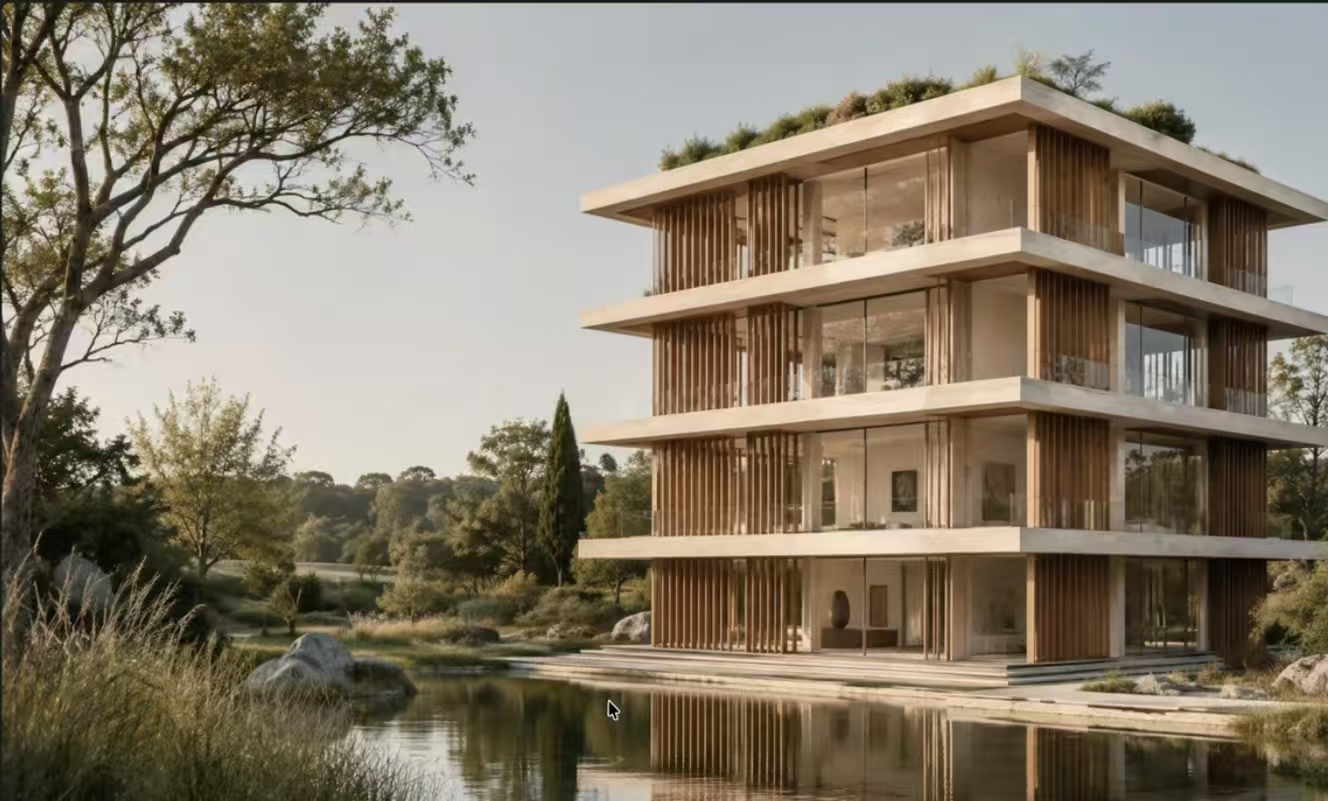
4 个 DemoPROMPT展开全文收起全文帮我复刻还原这个3D场景。以网页的形式。要求光影。布景都相同,尽量精细精美。
帮我复刻还原这个3D场景。以网页的形式。要求光影。布景都相同,尽量精细精美。
09
中国西南峡谷
暂无 DemoPROMPT展开全文收起全文超写实数字李生场景:中国西南深切峡谷地貌,V形山谷,陡峭花岗岩崖壁,岩层纹理清晰,谷底一条碧绿河流蜿蜒穿过,河面有阳光倒影和轻微波浪,河岸有碎石滩、低矮植被和蜿蜒公路。一座大跨度双塔地锚式悬索桥横跨峡谷,桥塔高耸,采用钢筋混凝土门形框架结构,主缆为空间索面,吊索密集垂直,加劲梁为扁平钢箱梁,双向六车道,桥面沥青铺装,车道标线清晰,桥上车辆密集,车来车往,形成动态车流,轿车、SUV、卡车、公交车混合行驶,车灯和尾灯拉出光轨。桥梁钢结构细节丰富:主缆、索夹、吊索锚头、钢箱梁焊缝、螺栓、防锈涂层、检修走道、栏杆、路灯、桥塔横梁、主鞍座、散索鞍、锚碇、减震阻尼器。山谷中有薄雾,远处群山层叠,可见风力发电机、高压输电塔和盘山公路。数字李生可视化叠加:半透明数据面板、传感器节点、激光点云叠加、BIM模型线框、实时交通热力图、桥梁结构应力云图、位移监测标记、无人机巡检路径。真实光照,全局光照,体积雾,PBR材质,8K分辨率,电影级构图,超写实渲染,Unreal Engine5,Cesium,倾斜摄影测量,GIS地理信息融合,Octane渲染。输出一个这样的一个单htm对该场景进行仿真。
超写实数字李生场景:中国西南深切峡谷地貌,V形山谷,陡峭花岗岩崖壁,岩层纹理清晰,谷底一条碧绿河流蜿蜒穿过,河面有阳光倒影和轻微波浪,河岸有碎石滩、低矮植被和蜿蜒公路。一座大跨度双塔地锚式悬索桥横跨峡谷,桥塔高耸,采用钢筋混凝土门形框架结构,主缆为空间索面,吊索密集垂直,加劲梁为扁平钢箱梁,双向六车道,桥面沥青铺装,车道标线清晰,桥上车辆密集,车来车往,形成动态车流,轿车、SUV、卡车、公交车混合行驶,车灯和尾灯拉出光轨。桥梁钢结构细节丰富:主缆、索夹、吊索锚头、钢箱梁焊缝、螺栓、防锈涂层、检修走道、栏杆、路灯、桥塔横梁、主鞍座、散索鞍、锚碇、减震阻尼器。山谷中有薄雾,远处群山层叠,可见风力发电机、高压输电塔和盘山公路。数字李生可视化叠加:半透明数据面板、传感器节点、激光点云叠加、BIM模型线框、实时交通热力图、桥梁结构应力云图、位移监测标记、无人机巡检路径。真实光照,全局光照,体积雾,PBR材质,8K分辨率,电影级构图,超写实渲染,Unreal Engine5,Cesium,倾斜摄影测量,GIS地理信息融合,Octane渲染。输出一个这样的一个单htm对该场景进行仿真。
暂无模型结果可分享
影视动画
3 项任务10
韩立对战温天仁
5 个 DemoPROMPT展开全文收起全文# 韩立对战温天仁:海岛上空的法术大战 使用 Three.js 创作一段具有电影质感、可以在浏览器中交互观看的三维仙侠战斗,配有 BGM 背景音乐,但不需要配音,呈现《凡人修仙传》中韩立为元瑶护法,在海岛外围迎战温天仁的故事。以原著的交锋顺序和法术克制关系为叙事依据,参考本目录视频中的角色造型、动作、镜头与特效表现,让观众看清双方如何试探、应变、暴露底牌,以及战局如何不断逆转。 参考视频:`参考视频/韩立对战温天仁-P1-P5合并.mp4`。 ## 原著关键战斗内容 第五百七十二章 苦斗 无数的噬金虫从袋中蜂拥而出,瞬间化为三色的巨大虫群,遍布在韩立头顶之上,足有二三十丈之广,看起来声势吓人之极。 紫云中金光乍现,接着无数的金丝从紫云中爆射而出,往四面八方射进了簇拥而上的虫云之中。随后“噗噗”之声响成一片,无数的虫尸,雨点一样的从空中密密麻麻坠落。这些金丝竟似是噬金虫的克星一样,飞虫那原本法宝难伤的身体,被这些金丝一扎即溃,根本无法抵挡分毫。 这些金丝同时往一处激射而去,转眼间凝结到了一起,变化出一柄金色小剑出来。此金剑轻轻一阵颤抖后,一下激射而出,瞬间就破开了花篮古宝的禁制,直向韩立飞袭而来。 第五百七十三章 阴魔斩与六极真魔 粗大的手臂猛然一缩,随后骤然一吐。一道黑红色光片,从手掌中激射而出,一脱手后,巨大到数丈之宽,随后“兹啦”之声响起,光片带出一道长长的尾芒,瞬息而至的飞到了云团之前。温天仁似乎意识到不妙,头顶和巨剑纠缠不清的青铜古盾,光华一闪,挡在了云团前。光片丝毫停顿没有,视若无物的一斩而过。铜盾泥捏一般,无声地一分为二,掉落尘埃。而盾后的云团中则传出一声闷哼,接着中间现出了一道黑色缝隙。片刻后,云团就如同碎裂的画卷一样,断裂成了两片。 在温天仁身后,隐隐显出了六个高大的虚影,或头上有角,或身披鳞甲,个个狰狞恐怖,口吐獠牙,灰白色魔气更是缠绕周身,犹如天魔降世一般。 韩立神情蓦然一冷,双手一抬后,两道粗若碗口的金色电弧,激射而出,一下击到了最近的两道虚影之上。让温天仁不敢相信的一幕出现了。两道虚影在雷鸣声中,身形一淡,脸上瞬间露出痛苦不堪的表情,然后灰光闪动后,一下化为了乌有。韩立手中辟邪神雷已再次弹出,又有两道粗大金弧,眨眼射到了另两道虚影之上,同样的“轰隆隆”的一闪灭掉了。 第五百七十四章 八门金光镜 温天仁两手一张,从衣袖中一连射出八团金色火焰出来。此刻它们光焰一熄,现出了八面纯金般打造的古镜出来。这些镜子巴掌般大小,一面光滑如水,隐有金光流动,另一面皱皱巴巴,凹凸不平,显得丑陋不堪。 他眉宇间金角,光华一闪,一道纤细金光突然喷出,一下射到离他最近的一面镜子上,然后飞快又弹射到隔壁的小镜上,转眼间弹射了八次,每一次弹射完后,金光就壮大几分,当从最后一面金镜上弹出时,金光已变得足有婴儿般手臂粗细。 第五百七十五章 金光神焰 八道光柱几乎在刚从镜中射出的同时,下一刻就到了韩立跟前,速度之快,让韩立也为之色变。“噗噗”之声接连传来,最外层数十道用剑影分光术幻化出来的剑光,在刚一和这些光柱接触的瞬间,立刻化为了乌有。即使那些青竹蜂云剑的本体,被这些金光一冲之下,通体青光一闪后,也毫无招架之力地被击飞了出去。后面的五行巨环,霞光一闪,倒是稍微阻挡了片刻,但随后就发出了哀鸣之声,彩霞狂闪,巨环就在韩立眼前寸寸地断裂崩溃,化为了无数粉末。 无数道金光从镜中铺天盖地的喷射而出,往其四周狂罩而下。结果在温天仁身后十余丈的地方,韩立的身形出现,无数道金光立刻一卷而上,将韩立死死困在了其中。韩立脸色大变,急忙催动身后的风雷翅,可身处金光中的他,身形如同凝固了一般,根本无法移动分毫。 温天仁面孔上呈现郑重之色,双手不停的结着各种复杂之极的手印,同时口中传出了低沉咒语之声。随后他一张口,数团精血接连喷出,每喷一口,其脸色就苍白一分,当八口精血一一喷进金焰之中时,他脸色已变的苍白无比,一丝血色也无法看到。可是那八团金焰,瞬间火光冲天,威力倍增起来。“能死在传闻中金光神焰之下,你也算死得其所了。” 韩立立刻被滔滔的金色火焰淹没在其中。这金焰一出现后,他周身的灵力以刚才五六倍的速度,从身上狂泻而出。否则那银色光罩立刻不稳,即将崩溃的样子。这样看来,对方是想用这金色火焰将他灵力耗尽,然后再活活将他炼化成灰。 第五百七十六章 鬼雾现 现在看起来,他似乎处在了下风。但是拥有半瓶万年灵液的他,其实根本有恃无恐。相反,不论困住他的金光,还是汹汹燃烧的金焰,温天仁都不可能一点代价没有的施展出来。对方和他拼斗起修为耐力,反而是他取胜的契机到了。 于是出现了奇怪的一幕,原本电闪雷鸣的空中,一下寂静无声了起来。温天仁和韩立,一上一下的各自掐诀静坐不语。只有那一堆数丈高的金色火焰,无声无息的燃烧着。 在离小岛百余里远的一处深海中,突然有诡异的黑光闪动,接着一道纤细的黑色裂缝出现在了那里。随后,从缝隙之中一下冒出了无数的漆黑雾气。这些雾气开始只有数丈大小,但马上急剧变大,片刻的功夫,就化为了里许大小,并还在不停的扩张中。而黑幽幽的雾气中,不但隐有鬼哭狼嚎之声传出,并且,还有奇怪的黑色闪电,在雾中不停的跳跃闪动。
# 韩立对战温天仁:海岛上空的法术大战
使用 Three.js 创作一段具有电影质感、可以在浏览器中交互观看的三维仙侠战斗,配有 BGM 背景音乐,但不需要配音,呈现《凡人修仙传》中韩立为元瑶护法,在海岛外围迎战温天仁的故事。以原著的交锋顺序和法术克制关系为叙事依据,参考本目录视频中的角色造型、动作、镜头与特效表现,让观众看清双方如何试探、应变、暴露底牌,以及战局如何不断逆转。
参考视频:`参考视频/韩立对战温天仁-P1-P5合并.mp4`。
## 原著关键战斗内容
第五百七十二章 苦斗
无数的噬金虫从袋中蜂拥而出,瞬间化为三色的巨大虫群,遍布在韩立头顶之上,足有二三十丈之广,看起来声势吓人之极。
紫云中金光乍现,接着无数的金丝从紫云中爆射而出,往四面八方射进了簇拥而上的虫云之中。随后“噗噗”之声响成一片,无数的虫尸,雨点一样的从空中密密麻麻坠落。这些金丝竟似是噬金虫的克星一样,飞虫那原本法宝难伤的身体,被这些金丝一扎即溃,根本无法抵挡分毫。
这些金丝同时往一处激射而去,转眼间凝结到了一起,变化出一柄金色小剑出来。此金剑轻轻一阵颤抖后,一下激射而出,瞬间就破开了花篮古宝的禁制,直向韩立飞袭而来。
第五百七十三章 阴魔斩与六极真魔
粗大的手臂猛然一缩,随后骤然一吐。一道黑红色光片,从手掌中激射而出,一脱手后,巨大到数丈之宽,随后“兹啦”之声响起,光片带出一道长长的尾芒,瞬息而至的飞到了云团之前。温天仁似乎意识到不妙,头顶和巨剑纠缠不清的青铜古盾,光华一闪,挡在了云团前。光片丝毫停顿没有,视若无物的一斩而过。铜盾泥捏一般,无声地一分为二,掉落尘埃。而盾后的云团中则传出一声闷哼,接着中间现出了一道黑色缝隙。片刻后,云团就如同碎裂的画卷一样,断裂成了两片。
在温天仁身后,隐隐显出了六个高大的虚影,或头上有角,或身披鳞甲,个个狰狞恐怖,口吐獠牙,灰白色魔气更是缠绕周身,犹如天魔降世一般。
韩立神情蓦然一冷,双手一抬后,两道粗若碗口的金色电弧,激射而出,一下击到了最近的两道虚影之上。让温天仁不敢相信的一幕出现了。两道虚影在雷鸣声中,身形一淡,脸上瞬间露出痛苦不堪的表情,然后灰光闪动后,一下化为了乌有。韩立手中辟邪神雷已再次弹出,又有两道粗大金弧,眨眼射到了另两道虚影之上,同样的“轰隆隆”的一闪灭掉了。
第五百七十四章 八门金光镜
温天仁两手一张,从衣袖中一连射出八团金色火焰出来。此刻它们光焰一熄,现出了八面纯金般打造的古镜出来。这些镜子巴掌般大小,一面光滑如水,隐有金光流动,另一面皱皱巴巴,凹凸不平,显得丑陋不堪。
他眉宇间金角,光华一闪,一道纤细金光突然喷出,一下射到离他最近的一面镜子上,然后飞快又弹射到隔壁的小镜上,转眼间弹射了八次,每一次弹射完后,金光就壮大几分,当从最后一面金镜上弹出时,金光已变得足有婴儿般手臂粗细。
第五百七十五章 金光神焰
八道光柱几乎在刚从镜中射出的同时,下一刻就到了韩立跟前,速度之快,让韩立也为之色变。“噗噗”之声接连传来,最外层数十道用剑影分光术幻化出来的剑光,在刚一和这些光柱接触的瞬间,立刻化为了乌有。即使那些青竹蜂云剑的本体,被这些金光一冲之下,通体青光一闪后,也毫无招架之力地被击飞了出去。后面的五行巨环,霞光一闪,倒是稍微阻挡了片刻,但随后就发出了哀鸣之声,彩霞狂闪,巨环就在韩立眼前寸寸地断裂崩溃,化为了无数粉末。
无数道金光从镜中铺天盖地的喷射而出,往其四周狂罩而下。结果在温天仁身后十余丈的地方,韩立的身形出现,无数道金光立刻一卷而上,将韩立死死困在了其中。韩立脸色大变,急忙催动身后的风雷翅,可身处金光中的他,身形如同凝固了一般,根本无法移动分毫。
温天仁面孔上呈现郑重之色,双手不停的结着各种复杂之极的手印,同时口中传出了低沉咒语之声。随后他一张口,数团精血接连喷出,每喷一口,其脸色就苍白一分,当八口精血一一喷进金焰之中时,他脸色已变的苍白无比,一丝血色也无法看到。可是那八团金焰,瞬间火光冲天,威力倍增起来。“能死在传闻中金光神焰之下,你也算死得其所了。”
韩立立刻被滔滔的金色火焰淹没在其中。这金焰一出现后,他周身的灵力以刚才五六倍的速度,从身上狂泻而出。否则那银色光罩立刻不稳,即将崩溃的样子。这样看来,对方是想用这金色火焰将他灵力耗尽,然后再活活将他炼化成灰。
第五百七十六章 鬼雾现
现在看起来,他似乎处在了下风。但是拥有半瓶万年灵液的他,其实根本有恃无恐。相反,不论困住他的金光,还是汹汹燃烧的金焰,温天仁都不可能一点代价没有的施展出来。对方和他拼斗起修为耐力,反而是他取胜的契机到了。
于是出现了奇怪的一幕,原本电闪雷鸣的空中,一下寂静无声了起来。温天仁和韩立,一上一下的各自掐诀静坐不语。只有那一堆数丈高的金色火焰,无声无息的燃烧着。
在离小岛百余里远的一处深海中,突然有诡异的黑光闪动,接着一道纤细的黑色裂缝出现在了那里。随后,从缝隙之中一下冒出了无数的漆黑雾气。这些雾气开始只有数丈大小,但马上急剧变大,片刻的功夫,就化为了里许大小,并还在不停的扩张中。而黑幽幽的雾气中,不但隐有鬼哭狼嚎之声传出,并且,还有奇怪的黑色闪电,在雾中不停的跳跃闪动。
11
流浪地球-点燃木星
8 个 DemoPROMPT展开全文收起全文使用 Three.js 创作一段具有电影级真实感的三维太空场景,呈现《流浪地球》中地球在行星发动机推动下接近木星、陷入潮汐撕裂危机,最终点燃两颗行星之间的混合气体并借助爆炸逃离的完整剧情。保留电影的科幻前提,同时让天体外观、空间尺度、物质运动和光照变化尽可能具有真实世界的可信度。 故事开始于深空。太阳已经成为遥远而冷淡的光源,地球是一颗遍布冰雪、海洋冻结、地表文明几乎沉入黑暗的流浪行星。大陆轮廓依然可辨,破碎云层与稀薄的大气辉光覆盖其上。大量行星发动机扎根于地表,巨大的工业基座与冰封山脉融为一体,蓝白色喷流刺穿云层,延伸至太空。近处能感受到发动机如山岳般庞大,远处则能看出它们仍只是地球曲面上细小而密集的光点。喷流拥有炽亮核心、逐渐扩散的外缘和不稳定的能量起伏,其朝向与地球受到的推进作用在空间关系上相互一致。 木星逐渐占据视野。它与地球之间存在压倒性的体量差,赭红、乳白与棕黄色云带沿球面延展,交界处布满剪切涡流与层叠风暴,大红斑嵌在广阔而深厚的大气之中。木星拥有明确的球体曲率、昼夜分界和极区变化;近距离时,它的弧形边缘甚至超出画面,像一面没有尽头、仍在缓慢翻涌的天空。地球在它面前显得脆弱而渺小,但两者始终保持清楚、可信的空间位置关系。 地球原本沿弯曲轨迹掠过木星,随后逐渐偏离安全航路。随着距离缩短,木星引力与潮汐作用带来的灾难持续加剧:地球大气向木星方向拉长,云层被抽成细长流带,冰封地表出现巨大裂隙,尘埃、冰晶和碎片从局部区域升起,沿不同轨迹被卷向太空。地球仍然保持整体结构,但已显露即将遭到撕裂的危险。所谓逼近洛希极限的危机,应当体现为不断增强的潮汐破坏,而不是太空中出现一道可见的边界。 两颗行星之间逐渐形成一条危险的气体连接区域。来自地球的大气与木星外层逸出的气体,在电影设定下形成能够被点燃的局部混合带。它横跨黑暗空间,呈现稀薄、半透明、流动不均的形态,内部夹杂旋涡、丝状结构与漂浮碎屑;靠近两颗行星的部分更为厚重,中间部分则断续、脆弱。它的形成与变化,应当让人感受到两颗巨大天体正在交换和剥离物质。 危机最深时,地表的行星发动机接连提升功率。冰原被蓝白色光芒照亮,巨型设施周围的云层剧烈扰动,喷流的亮度与长度不断增长。其中一道关键喷流向混合气体区域延伸,在极端悬殊的尺度中显得纤细却顽强。点火前存在一段紧绷的接近过程:喷流顶端与气体带之间仍有距离,地球继续下坠,碎片继续被剥离,发动机仍在挣扎。 点燃发生在局部,而后迅速扩展。最初是一个极其明亮的接触点,紧接着,燃烧前沿沿着可燃混合区域奔涌,形成巨大而不规则的发光界面。不同密度的气体呈现不同的燃烧速度、亮度与翻卷形态,炽白核心过渡到金黄、橙红与逐渐冷却的暗色气体。被点燃的是两颗行星之间的混合物质,木星本体依旧完整,庞大的云带在强光映照下显现出更加深沉的层次。 爆炸抵达高潮时,膨胀的高温气体与被照亮的物质席卷地球附近。强光沿地球曲面扫过,云层、冰面、裂隙和发动机设施先后被照亮,行星背面仍保留深重阴影。气体中的冲击与真空中飞散的碎片呈现不同的运动特征,整个过程具有可感知的传播时间与空间层次。观众能够看清爆炸从哪里开始、向哪里扩展,以及它在电影设定下如何改变地球的运动。 地球没有瞬间掉头,也没有突然停止下坠,而是在原有运动基础上逐渐偏转,终于与木星拉开距离。被拉长的大气连接带断裂,部分气体与碎片继续坠向木星,其余物质留在地球身后形成缓慢散开的轨迹。行星发动机依然燃烧,地球带着受损的大气与冰封地表逃出最危险的接近区,重新驶向深空。 结尾回到辽阔而寂静的宇宙。木星仍然巨大,爆炸余辉在其边缘逐渐消退;地球缓慢远去,蓝白色发动机光芒成为黑暗中微小却坚定的航标。最终留下的感受应当是:人类借助难以想象的工程规模,推动一颗真实而沉重的星球,从另一颗巨行星的引力深渊边缘艰难逃生。 整段场景具有连续、清晰的空间关系与剧情因果。近景中的工业结构、地球尺度的灾难和远景中的天体运动属于同一个可信的三维世界。视觉风格接近真实太空摄影与严肃科幻电影:材质具有细节和尺度感,光照有明确来源,亮部保留层次,暗部保留深度,运动体现巨大质量与惯性。震撼主要来自天体尺度、逼近过程与物质变化,而非满屏光效。画面本身足以讲清这次接近、灾难、点燃与逃离的完整故事。
使用 Three.js 创作一段具有电影级真实感的三维太空场景,呈现《流浪地球》中地球在行星发动机推动下接近木星、陷入潮汐撕裂危机,最终点燃两颗行星之间的混合气体并借助爆炸逃离的完整剧情。保留电影的科幻前提,同时让天体外观、空间尺度、物质运动和光照变化尽可能具有真实世界的可信度。
故事开始于深空。太阳已经成为遥远而冷淡的光源,地球是一颗遍布冰雪、海洋冻结、地表文明几乎沉入黑暗的流浪行星。大陆轮廓依然可辨,破碎云层与稀薄的大气辉光覆盖其上。大量行星发动机扎根于地表,巨大的工业基座与冰封山脉融为一体,蓝白色喷流刺穿云层,延伸至太空。近处能感受到发动机如山岳般庞大,远处则能看出它们仍只是地球曲面上细小而密集的光点。喷流拥有炽亮核心、逐渐扩散的外缘和不稳定的能量起伏,其朝向与地球受到的推进作用在空间关系上相互一致。
木星逐渐占据视野。它与地球之间存在压倒性的体量差,赭红、乳白与棕黄色云带沿球面延展,交界处布满剪切涡流与层叠风暴,大红斑嵌在广阔而深厚的大气之中。木星拥有明确的球体曲率、昼夜分界和极区变化;近距离时,它的弧形边缘甚至超出画面,像一面没有尽头、仍在缓慢翻涌的天空。地球在它面前显得脆弱而渺小,但两者始终保持清楚、可信的空间位置关系。
地球原本沿弯曲轨迹掠过木星,随后逐渐偏离安全航路。随着距离缩短,木星引力与潮汐作用带来的灾难持续加剧:地球大气向木星方向拉长,云层被抽成细长流带,冰封地表出现巨大裂隙,尘埃、冰晶和碎片从局部区域升起,沿不同轨迹被卷向太空。地球仍然保持整体结构,但已显露即将遭到撕裂的危险。所谓逼近洛希极限的危机,应当体现为不断增强的潮汐破坏,而不是太空中出现一道可见的边界。
两颗行星之间逐渐形成一条危险的气体连接区域。来自地球的大气与木星外层逸出的气体,在电影设定下形成能够被点燃的局部混合带。它横跨黑暗空间,呈现稀薄、半透明、流动不均的形态,内部夹杂旋涡、丝状结构与漂浮碎屑;靠近两颗行星的部分更为厚重,中间部分则断续、脆弱。它的形成与变化,应当让人感受到两颗巨大天体正在交换和剥离物质。
危机最深时,地表的行星发动机接连提升功率。冰原被蓝白色光芒照亮,巨型设施周围的云层剧烈扰动,喷流的亮度与长度不断增长。其中一道关键喷流向混合气体区域延伸,在极端悬殊的尺度中显得纤细却顽强。点火前存在一段紧绷的接近过程:喷流顶端与气体带之间仍有距离,地球继续下坠,碎片继续被剥离,发动机仍在挣扎。
点燃发生在局部,而后迅速扩展。最初是一个极其明亮的接触点,紧接着,燃烧前沿沿着可燃混合区域奔涌,形成巨大而不规则的发光界面。不同密度的气体呈现不同的燃烧速度、亮度与翻卷形态,炽白核心过渡到金黄、橙红与逐渐冷却的暗色气体。被点燃的是两颗行星之间的混合物质,木星本体依旧完整,庞大的云带在强光映照下显现出更加深沉的层次。
爆炸抵达高潮时,膨胀的高温气体与被照亮的物质席卷地球附近。强光沿地球曲面扫过,云层、冰面、裂隙和发动机设施先后被照亮,行星背面仍保留深重阴影。气体中的冲击与真空中飞散的碎片呈现不同的运动特征,整个过程具有可感知的传播时间与空间层次。观众能够看清爆炸从哪里开始、向哪里扩展,以及它在电影设定下如何改变地球的运动。
地球没有瞬间掉头,也没有突然停止下坠,而是在原有运动基础上逐渐偏转,终于与木星拉开距离。被拉长的大气连接带断裂,部分气体与碎片继续坠向木星,其余物质留在地球身后形成缓慢散开的轨迹。行星发动机依然燃烧,地球带着受损的大气与冰封地表逃出最危险的接近区,重新驶向深空。
结尾回到辽阔而寂静的宇宙。木星仍然巨大,爆炸余辉在其边缘逐渐消退;地球缓慢远去,蓝白色发动机光芒成为黑暗中微小却坚定的航标。最终留下的感受应当是:人类借助难以想象的工程规模,推动一颗真实而沉重的星球,从另一颗巨行星的引力深渊边缘艰难逃生。
整段场景具有连续、清晰的空间关系与剧情因果。近景中的工业结构、地球尺度的灾难和远景中的天体运动属于同一个可信的三维世界。视觉风格接近真实太空摄影与严肃科幻电影:材质具有细节和尺度感,光照有明确来源,亮部保留层次,暗部保留深度,运动体现巨大质量与惯性。震撼主要来自天体尺度、逼近过程与物质变化,而非满屏光效。画面本身足以讲清这次接近、灾难、点燃与逃离的完整故事。
12
黑洞
1 个 DemoPROMPT展开全文收起全文请使用 Blender 创建一个具有电影级视觉质感的 3D 黑洞场景,整体参考《星际穿越》中 Gargantua 黑洞所呈现出的科学写实视觉语言,但不要直接复制任何具体电影镜头。 目标不是创建一个普通的“黑色球体 + 发光圆环”,而是制作一个具有: - 事件视界 - 光子环 - 动态吸积盘 - 引力透镜 - 星空扭曲 - 相对论视觉效果 - 电影级镜头和后期 的完整黑洞镜头。 最终目标是制作约 10~20 秒的电影感动画。 一、黑洞主体 黑洞本身不要设计复杂模型。 中心区域应该呈现一个完全黑暗的事件视界。 要求: - 无表面纹理 - 无反射 - 无明显球体光照 - 无普通 3D 球感 黑洞应该更像一个“光无法逃逸的区域”,而不是一个黑色星球。 事件视界周围加入非常细的光子环。 光子环: - 极亮 - 非常薄 - 接近暖白色 - 局部可以带轻微金黄色 - 不要形成厚重霓虹圈 二、吸积盘 创建一个围绕黑洞高速旋转的扁平吸积盘。 吸积盘不是普通实体圆环。 建议使用: - Geometry Nodes - Shader Nodes - Volume - 程序化纹理 结合实现。 吸积盘需要具有多个径向层次: 外部: 暗橙色 / 深金色。 中部: 暖黄色。 内部: 接近白热状态。 越靠近黑洞,温度和亮度越高。 材质应该表现为: - 高温等离子体 - 气体 - 尘埃 - 高速运动产生的条纹 使用程序化 Noise、Voronoi、Wave Texture 或自定义节点,让纹理沿环形方向高速流动。 不要让整个 Mesh 机械地匀速旋转。 不同半径应该具有不同流速: 越靠近黑洞速度越快。 制造明显的差速旋转感。 动画过程中: - 热斑不断移动 - 气体纹理变化 - 局部亮度变化 - 结构始终保持自然连续 禁止出现明显重复纹理。 三、引力透镜 这是整个场景最核心的部分。 必须表现黑洞对光线的弯曲。 不能只通过几何建模直接做两个吸积盘。 需要尽可能使用: - Shader - Ray Marching - Camera Shader - Compositor - Geometry Nodes - 自定义 OSL / Python / GLSL 类方案 模拟黑洞附近光线扭曲。 视觉上必须看到: 吸积盘背后的部分,被黑洞引力弯折到: - 黑洞上方 - 黑洞下方 形成明显的透镜结构。 从正面略带倾斜的角度观察时: 吸积盘主体横向贯穿黑洞。 黑洞上方形成一条弯曲的亮弧。 黑洞下方形成另一条较暗的弯曲结构。 背景星空经过黑洞附近时,同样应该被弯曲。 越靠近事件视界: 扭曲程度越强。 不要简单使用普通 Lens Distortion。 最终效果需要明显像“时空弯曲”。 如果完整广义相对论计算实现难度过高,可以采用视觉近似方式,但必须保证: - 黑洞中心稳定 - 周围星空产生径向非线性扭曲 - 吸积盘背面被正确翻卷到上下区域 - 透镜效果随距离平滑变化 四、相对论视觉效果 加入适度的相对论视觉差异。 吸积盘朝向观察者的一侧可以: - 更亮 - 稍微偏白或偏蓝 远离观察者的一侧: - 稍暗 - 稍偏暖色 模拟 Doppler Beaming 和相对论性多普勒变化。 不要过度使用蓝红双色。 视觉依然保持《星际穿越》式的: 暖白 + 金色 + 黑色。 五、背景宇宙 创建深黑宇宙背景。 加入真实感星空。 包含: - 大量微弱恒星 - 少量较亮恒星 - 极少量远方星云 - 极少量远方星系 背景不能过于繁杂。 避免出现明显银河照片贴图感。 可以使用: - World Shader - 程序化星空 - 大型 Sphere 星空 - 粒子恒星 需要保证在相机运动过程中具有真实空间深度。 六、摄影机 使用电影镜头设计。 建议使用长焦或中长焦视觉。 不要使用夸张超广角。 镜头动画: 开场从较远位置观察黑洞。 黑洞只占画面较小区域。 随后镜头非常缓慢向前推进。 黑洞逐渐扩大。 吸积盘和透镜结构逐渐清晰。 最终黑洞约占画面高度 40%~55%。 镜头运动必须: - 极慢 - 稳定 - 有重量感 可以加入非常轻微的漂浮。 不要: - 快速摇镜 - 快速旋转 - 强烈手持 - 快速推拉 如果需要镜头绕行,只移动非常小的角度。 让观众能够感知 3D 空间,但不要破坏黑洞的宏伟感。 七、渲染 优先考虑 Blender Cycles。 如果使用 Eevee,也必须确保最终视觉达到电影质感。 建议: - 高采样 - 合理降噪 - 高动态范围 - Filmic / AgX 色彩管理 - 高光保护 - 深黑控制 避免: - 过曝 - 大面积死白 - 过度锐化 - 过高饱和度 八、Compositor 后期 使用 Blender Compositor 完成最终电影后期。 加入: - Glare / Bloom - Vignette - Color Balance - Exposure - Contrast - 非常轻微 Lens Distortion - 非常轻微 Chromatic Aberration - 极低强度 Film Grain 吸积盘高亮部分应该产生自然的柔和辉光。 不要让辉光覆盖黑洞事件视界。 黑洞中心必须保持纯粹的深黑。 九、动画节奏 建议: 24 FPS。 时长: 10~20 秒。 推荐节奏: 0~2 秒: 深空,黑洞较远。 2~6 秒: 镜头开始缓慢靠近。 6~12 秒: 黑洞进入主要画面区域,吸积盘流动明显。 12~16 秒: 完整展示引力透镜结构。 最后: 镜头保持缓慢向前移动,不做明显结束动作。 可以形成无缝或接近无缝循环。 十、构图要求 保持极简。 画面主要只有: 黑洞 + 吸积盘 + 星空。 不要加入: - 飞船 - 宇航员 - 行星 - 文字 - UI - Logo - 巨大星云 - 科幻建筑 黑洞必须是绝对视觉主体。 十一、项目组织 请合理整理 Blender 项目: Collections: - BlackHole - AccretionDisk - PhotonRing - Stars - Camera - Lights - FX 材质名称清晰。 节点结构整理整齐。 动画参数尽量可以集中控制,例如: - Black Hole Radius - Accretion Disk Inner Radius - Accretion Disk Outer Radius - Disk Rotation Speed - Disk Brightness - Lensing Strength - Photon Ring Intensity - Camera Distance 如果可以,制作一组方便调节的自定义属性。 最终目标 成片需要给人一种: “这不是一个 Blender 教程练习,而是一段真正的科幻电影镜头。” 视觉重点排序: 1. 引力透镜 2. 吸积盘真实流动 3. 黑洞事件视界 4. 相对论光照变化 5. 星空扭曲 6. 摄影机运动 7. 后期辉光 保持写实、克制、宏大。 不要为了“炫技”增加无意义复杂元素。
请使用 Blender 创建一个具有电影级视觉质感的 3D 黑洞场景,整体参考《星际穿越》中 Gargantua 黑洞所呈现出的科学写实视觉语言,但不要直接复制任何具体电影镜头。
目标不是创建一个普通的“黑色球体 + 发光圆环”,而是制作一个具有:
- 事件视界
- 光子环
- 动态吸积盘
- 引力透镜
- 星空扭曲
- 相对论视觉效果
- 电影级镜头和后期
的完整黑洞镜头。
最终目标是制作约 10~20 秒的电影感动画。
一、黑洞主体
黑洞本身不要设计复杂模型。
中心区域应该呈现一个完全黑暗的事件视界。
要求:
- 无表面纹理
- 无反射
- 无明显球体光照
- 无普通 3D 球感
黑洞应该更像一个“光无法逃逸的区域”,而不是一个黑色星球。
事件视界周围加入非常细的光子环。
光子环:
- 极亮
- 非常薄
- 接近暖白色
- 局部可以带轻微金黄色
- 不要形成厚重霓虹圈
二、吸积盘
创建一个围绕黑洞高速旋转的扁平吸积盘。
吸积盘不是普通实体圆环。
建议使用:
- Geometry Nodes
- Shader Nodes
- Volume
- 程序化纹理
结合实现。
吸积盘需要具有多个径向层次:
外部:
暗橙色 / 深金色。
中部:
暖黄色。
内部:
接近白热状态。
越靠近黑洞,温度和亮度越高。
材质应该表现为:
- 高温等离子体
- 气体
- 尘埃
- 高速运动产生的条纹
使用程序化 Noise、Voronoi、Wave Texture 或自定义节点,让纹理沿环形方向高速流动。
不要让整个 Mesh 机械地匀速旋转。
不同半径应该具有不同流速:
越靠近黑洞速度越快。
制造明显的差速旋转感。
动画过程中:
- 热斑不断移动
- 气体纹理变化
- 局部亮度变化
- 结构始终保持自然连续
禁止出现明显重复纹理。
三、引力透镜
这是整个场景最核心的部分。
必须表现黑洞对光线的弯曲。
不能只通过几何建模直接做两个吸积盘。
需要尽可能使用:
- Shader
- Ray Marching
- Camera Shader
- Compositor
- Geometry Nodes
- 自定义 OSL / Python / GLSL 类方案
模拟黑洞附近光线扭曲。
视觉上必须看到:
吸积盘背后的部分,被黑洞引力弯折到:
- 黑洞上方
- 黑洞下方
形成明显的透镜结构。
从正面略带倾斜的角度观察时:
吸积盘主体横向贯穿黑洞。
黑洞上方形成一条弯曲的亮弧。
黑洞下方形成另一条较暗的弯曲结构。
背景星空经过黑洞附近时,同样应该被弯曲。
越靠近事件视界:
扭曲程度越强。
不要简单使用普通 Lens Distortion。
最终效果需要明显像“时空弯曲”。
如果完整广义相对论计算实现难度过高,可以采用视觉近似方式,但必须保证:
- 黑洞中心稳定
- 周围星空产生径向非线性扭曲
- 吸积盘背面被正确翻卷到上下区域
- 透镜效果随距离平滑变化
四、相对论视觉效果
加入适度的相对论视觉差异。
吸积盘朝向观察者的一侧可以:
- 更亮
- 稍微偏白或偏蓝
远离观察者的一侧:
- 稍暗
- 稍偏暖色
模拟 Doppler Beaming 和相对论性多普勒变化。
不要过度使用蓝红双色。
视觉依然保持《星际穿越》式的:
暖白 + 金色 + 黑色。
五、背景宇宙
创建深黑宇宙背景。
加入真实感星空。
包含:
- 大量微弱恒星
- 少量较亮恒星
- 极少量远方星云
- 极少量远方星系
背景不能过于繁杂。
避免出现明显银河照片贴图感。
可以使用:
- World Shader
- 程序化星空
- 大型 Sphere 星空
- 粒子恒星
需要保证在相机运动过程中具有真实空间深度。
六、摄影机
使用电影镜头设计。
建议使用长焦或中长焦视觉。
不要使用夸张超广角。
镜头动画:
开场从较远位置观察黑洞。
黑洞只占画面较小区域。
随后镜头非常缓慢向前推进。
黑洞逐渐扩大。
吸积盘和透镜结构逐渐清晰。
最终黑洞约占画面高度 40%~55%。
镜头运动必须:
- 极慢
- 稳定
- 有重量感
可以加入非常轻微的漂浮。
不要:
- 快速摇镜
- 快速旋转
- 强烈手持
- 快速推拉
如果需要镜头绕行,只移动非常小的角度。
让观众能够感知 3D 空间,但不要破坏黑洞的宏伟感。
七、渲染
优先考虑 Blender Cycles。
如果使用 Eevee,也必须确保最终视觉达到电影质感。
建议:
- 高采样
- 合理降噪
- 高动态范围
- Filmic / AgX 色彩管理
- 高光保护
- 深黑控制
避免:
- 过曝
- 大面积死白
- 过度锐化
- 过高饱和度
八、Compositor 后期
使用 Blender Compositor 完成最终电影后期。
加入:
- Glare / Bloom
- Vignette
- Color Balance
- Exposure
- Contrast
- 非常轻微 Lens Distortion
- 非常轻微 Chromatic Aberration
- 极低强度 Film Grain
吸积盘高亮部分应该产生自然的柔和辉光。
不要让辉光覆盖黑洞事件视界。
黑洞中心必须保持纯粹的深黑。
九、动画节奏
建议:
24 FPS。
时长:
10~20 秒。
推荐节奏:
0~2 秒:
深空,黑洞较远。
2~6 秒:
镜头开始缓慢靠近。
6~12 秒:
黑洞进入主要画面区域,吸积盘流动明显。
12~16 秒:
完整展示引力透镜结构。
最后:
镜头保持缓慢向前移动,不做明显结束动作。
可以形成无缝或接近无缝循环。
十、构图要求
保持极简。
画面主要只有:
黑洞 + 吸积盘 + 星空。
不要加入:
- 飞船
- 宇航员
- 行星
- 文字
- UI
- Logo
- 巨大星云
- 科幻建筑
黑洞必须是绝对视觉主体。
十一、项目组织
请合理整理 Blender 项目:
Collections:
- BlackHole
- AccretionDisk
- PhotonRing
- Stars
- Camera
- Lights
- FX
材质名称清晰。
节点结构整理整齐。
动画参数尽量可以集中控制,例如:
- Black Hole Radius
- Accretion Disk Inner Radius
- Accretion Disk Outer Radius
- Disk Rotation Speed
- Disk Brightness
- Lensing Strength
- Photon Ring Intensity
- Camera Distance
如果可以,制作一组方便调节的自定义属性。
最终目标
成片需要给人一种:
“这不是一个 Blender 教程练习,而是一段真正的科幻电影镜头。”
视觉重点排序:
1. 引力透镜
2. 吸积盘真实流动
3. 黑洞事件视界
4. 相对论光照变化
5. 星空扭曲
6. 摄影机运动
7. 后期辉光
保持写实、克制、宏大。
不要为了“炫技”增加无意义复杂元素。
后端
2 项任务13
BullMQ真实代码库修复
5 个 DemoPROMPT展开全文收起全文你接手了一份已有的BullMQ代码库。系统能正常构建,普通任务也能完成,但在复杂使用场景下出现了一些异常: - 任务重新派发或批量续租后,执行状态偶尔不符合预期。 - 长时间运行、优先级与重试配置组合使用时,处理顺序或等待时间异常。 - 复用去重标识、组合使用保留策略时,部分数据的生命周期不正确。 - 跨队列工作流等待依赖较久后,父任务调度或失败记录出现偏差。 - 混合查询不同类型的依赖时,分页结果偶尔不完整。 请自行研究代码与文档,设计复现场景,定位并修复这些问题,补充有针对性的回归测试。保持公开API和现有正常行为兼容,不要通过禁用功能、吞掉错误或拒绝正常请求掩盖问题。 提交源码修改、新增测试,以及简短的根因与验证说明。不要修改或删除已有测试来让结果变绿。
你接手了一份已有的BullMQ代码库。系统能正常构建,普通任务也能完成,但在复杂使用场景下出现了一些异常:
- 任务重新派发或批量续租后,执行状态偶尔不符合预期。
- 长时间运行、优先级与重试配置组合使用时,处理顺序或等待时间异常。
- 复用去重标识、组合使用保留策略时,部分数据的生命周期不正确。
- 跨队列工作流等待依赖较久后,父任务调度或失败记录出现偏差。
- 混合查询不同类型的依赖时,分页结果偶尔不完整。
请自行研究代码与文档,设计复现场景,定位并修复这些问题,补充有针对性的回归测试。保持公开API和现有正常行为兼容,不要通过禁用功能、吞掉错误或拒绝正常请求掩盖问题。
提交源码修改、新增测试,以及简短的根因与验证说明。不要修改或删除已有测试来让结果变绿。
01
GPT-6 Sol
02
DeepSeek-V4.1-Flash-1017
03
GPT-6.1 Terra
04
GPT-6 Astra
05
Hy4
14
tusd上传一致性综合修复
3 个 DemoPROMPT展开全文收起全文# tusd 上传一致性与生命周期故障修复 你接手了一份 Go 编写的 tusd 断点续传服务。普通单次上传仍可使用,但在请求中断、重试、并发访问、长度声明、上传合并和服务重启等情况下,出现了以下问题: - 请求被停止后,有时仍消耗上传数据,或向客户端报告成功;客户端断开后,存储和事件处理的收尾时间也不符合配置。 - 同一上传被多个请求访问时,锁交接、偏移校验与实际写入行为不一致。 - 某些流式上传和延迟长度声明不能正确执行大小限制。 - 上传完成失败或业务回调拒绝操作时,服务仍可能宣告成功;服务端主动停止的资源处理也不符合原有契约。 - 合并上传的内容可能与客户端指定的顺序不一致,部分元数据在重启后丢失。 请研究现有源码、公开接口、项目文档和测试,设计可重复的复现场景,定位并修复相关问题,补充回归测试。以原 tusd 的接口契约和正常行为为准;现有实现或注释不自动构成正确需求。不能仅消除测试报错、修改响应文案,或通过禁用功能绕过故障。 ## 行为要求 1. 请求生命周期应正确处理准备阶段及传输阶段的停止、中断与普通客户端取消。保留已经接收且依契约应保存的数据,正确传播错误,并按配置给存储和事件处理留下收尾窗口。 2. 同一上传的操作应保持互斥;接管、等待者取消、多个等待者和旧请求的收尾不能破坏锁。不同上传仍可独立运行。客户端偏移不一致时不得悄悄改变文件内容。 3. 已知或未知 HTTP 请求长度、固定或延迟上传总长,都必须遵守相应大小与长度约束。正常短分块、合法续传和合法长度声明继续工作。 4. 创建、写入、完成、主动停止等阶段应遵守存储接口与 hook 的契约,保留既有错误优先级、自定义响应、事件及终止语义,不能将关键失败伪装为成功。 5. 合并内容应符合客户端指定的源资源顺序与列表语义。必须持久保存的上传状态,在重新打开存储和进程重启后仍应一致。 不得通过全局串行化、禁用接管/合并/延迟长度、统一吞掉错误、丢弃部分数据、拒绝所有边界请求或硬编码测试样例实现“修复”。 ## 修改范围 - 只允许修改或新增 `pkg/handler`、`pkg/memorylocker`、`pkg/filestore` 下的生产 Go 源码。可以新增测试和 Markdown 说明。 - 保持公开 API 签名和相关兼容行为;保留 go.mod、go.sum、依赖版本、构建配置,以及其他生产模块。 - 不得修改、删除、跳过已有测试,或弱化其断言;初始代码已有测试失败,这是待修复问题的一部分。 - 必须实际交付源码修复和新增回归测试。在源码根目录新增 `REPAIR_NOTES.md`,记录根因、修改、兼容性、实际验证命令与结果、尚未解决的问题。 ## 验证要求 先阅读 BENCHMARK_ENV.md。至少实际运行: ```sh go test -count=1 ./pkg/handler ./pkg/memorylocker ./pkg/filestore go test -race -count=1 ./pkg/handler ./pkg/memorylocker ./pkg/filestore ``` 并发测试优先使用明确同步点或 `testing/synctest`,断言响应、偏移、最终数据或持久状态,不以“没有 panic”代替正确性。正常路径也应受到保护。无法运行、失败或超时必须如实说明,不能记为通过。 独立根据本地源码诊断,不得使用网上现成修复、上游历史、其他模型作答或评审材料。不得根据测试名称、固定路径、上传 ID、环境变量或检测测试运行方式来切换生产行为。
# tusd 上传一致性与生命周期故障修复
你接手了一份 Go 编写的 tusd 断点续传服务。普通单次上传仍可使用,但在请求中断、重试、并发访问、长度声明、上传合并和服务重启等情况下,出现了以下问题:
- 请求被停止后,有时仍消耗上传数据,或向客户端报告成功;客户端断开后,存储和事件处理的收尾时间也不符合配置。
- 同一上传被多个请求访问时,锁交接、偏移校验与实际写入行为不一致。
- 某些流式上传和延迟长度声明不能正确执行大小限制。
- 上传完成失败或业务回调拒绝操作时,服务仍可能宣告成功;服务端主动停止的资源处理也不符合原有契约。
- 合并上传的内容可能与客户端指定的顺序不一致,部分元数据在重启后丢失。
请研究现有源码、公开接口、项目文档和测试,设计可重复的复现场景,定位并修复相关问题,补充回归测试。以原 tusd 的接口契约和正常行为为准;现有实现或注释不自动构成正确需求。不能仅消除测试报错、修改响应文案,或通过禁用功能绕过故障。
## 行为要求
1. 请求生命周期应正确处理准备阶段及传输阶段的停止、中断与普通客户端取消。保留已经接收且依契约应保存的数据,正确传播错误,并按配置给存储和事件处理留下收尾窗口。
2. 同一上传的操作应保持互斥;接管、等待者取消、多个等待者和旧请求的收尾不能破坏锁。不同上传仍可独立运行。客户端偏移不一致时不得悄悄改变文件内容。
3. 已知或未知 HTTP 请求长度、固定或延迟上传总长,都必须遵守相应大小与长度约束。正常短分块、合法续传和合法长度声明继续工作。
4. 创建、写入、完成、主动停止等阶段应遵守存储接口与 hook 的契约,保留既有错误优先级、自定义响应、事件及终止语义,不能将关键失败伪装为成功。
5. 合并内容应符合客户端指定的源资源顺序与列表语义。必须持久保存的上传状态,在重新打开存储和进程重启后仍应一致。
不得通过全局串行化、禁用接管/合并/延迟长度、统一吞掉错误、丢弃部分数据、拒绝所有边界请求或硬编码测试样例实现“修复”。
## 修改范围
- 只允许修改或新增 `pkg/handler`、`pkg/memorylocker`、`pkg/filestore` 下的生产 Go 源码。可以新增测试和 Markdown 说明。
- 保持公开 API 签名和相关兼容行为;保留 go.mod、go.sum、依赖版本、构建配置,以及其他生产模块。
- 不得修改、删除、跳过已有测试,或弱化其断言;初始代码已有测试失败,这是待修复问题的一部分。
- 必须实际交付源码修复和新增回归测试。在源码根目录新增 `REPAIR_NOTES.md`,记录根因、修改、兼容性、实际验证命令与结果、尚未解决的问题。
## 验证要求
先阅读 BENCHMARK_ENV.md。至少实际运行:
```sh
go test -count=1 ./pkg/handler ./pkg/memorylocker ./pkg/filestore
go test -race -count=1 ./pkg/handler ./pkg/memorylocker ./pkg/filestore
```
并发测试优先使用明确同步点或 `testing/synctest`,断言响应、偏移、最终数据或持久状态,不以“没有 panic”代替正确性。正常路径也应受到保护。无法运行、失败或超时必须如实说明,不能记为通过。
独立根据本地源码诊断,不得使用网上现成修复、上游历史、其他模型作答或评审材料。不得根据测试名称、固定路径、上传 ID、环境变量或检测测试运行方式来切换生产行为。
01
DeepSeek-V4.1-Flash-1017
02
GPT-6.1 Terra
03
GPT-6 Astra
办公
1 项任务15
DeepSeek Harness PPT介绍
5 个 DemoPROMPT展开全文收起全文做一个ppt,用来介绍DeepSeek Harness,浅色调背景
做一个ppt,用来介绍DeepSeek Harness,浅色调背景
科学
3 项任务16
无三角形与四边形图构造
2 个 DemoPROMPT展开全文收起全文# Task: The extremal function ex(n, {C3, C4}) — Independent Construction All paths below are relative to the directory containing this prompt (`无三角形与四边形图构造`). Start in that directory. All supplied dependencies, verifier files, and the visual reference are under `形式化验证/`. Create your search/plotting programs and final `outputs/` in this task directory, alongside the prompt, not inside the verifier. A Lean 4 project lives in `形式化验证/app/`. `形式化验证/app/Task/Basic.lean` contains a definition layer and a claim slot (`submission_lower`) — prove the strongest claim you can. This task evaluates your ability to implement and run a construction/search method, not your ability to retrieve an existing graph. The verifier evaluates the edge count certified by your proof; source-provenance requirements below are an additional condition of a compliant submission. The extremal function `ex(n, {C3, C4})` is the largest number of edges in a graph on `n` vertices containing **no triangle (`C3`) and no 4-cycle (`C4`)** — equivalently, a graph of girth (shortest cycle length) at least 5. It is a classic Erdős extremal problem; even the asymptotic leading constant is open. This task fixes **125 vertices** and uses **638 edges as a frozen numerical reference for scoring**. Construct a valid graph with as many edges as you can within the budget. The reference is not a pass/fail threshold or a promise that an independent run will reach it. A graph with fewer than 638 edges is an acceptable result if it is valid, honestly reported, and produced under the rules below. More verified edges are better. Do not search for or retrieve the graph behind the reference value. Reaching 639 edges would exceed this task's numerical reference, but this evaluation does not require you to research or claim a new world record. This task is unrelated to the Ramsey-style tasks in the library (`ramsey-r3-10` and friends): there the number of *vertices* is the objective and large *independent sets* are what you avoid; here the order is fixed at 125, *4-cycles* are what you avoid, and the *edge count* is the objective. The only superficial overlap is "no triangles". ## What's in `形式化验证/app/Task/Basic.lean` The file has two zones: - **Definition zone (do not modify).** The fixed definition layer gives you: - `Gph n` — a graph on `n` vertices as an adjacency function `adj : Nat → Nat → Bool` (data only, no proof fields); - `ofEdges n es` — builds a `Gph n` from an edge list `es : List (Nat × Nat)` (symmetric closure); - `WellFormed n g : Bool` — the adjacency is symmetric and loopless; - `edgeCount n g : Nat` — the number of edges (pairs `i < j`); - `NoC3 n g : Bool` — no triangle (no triple with all three adjacencies); - `NoC4 n g : Bool` — no 4-cycle, as pure counting: any two distinct vertices have at most one common neighbour; - `C3C4Free n g : Bool` — `NoC3 && NoC4` (girth at least 5). - **Claim slot.** Below the line `-- END OF FIXED PART`, prove the claim `submission_lower`: ```lean theorem submission_lower : ∃ g : Gph 125, WellFormed 125 g = true ∧ C3C4Free 125 g = true ∧ edgeCount 125 g ≥ m ``` where **you choose the numeral `m`** — the larger the better. You may change **only** that numeral in the claim statement (the four `125`s are fixed); the claim body must stay between its `-- CLAIM submission_lower BEGIN/END` markers. Everything is a computable `Bool` predicate over concrete data, so a certificate is just a witness edge list plus evaluation: ```lean def myEdges : List (Nat × Nat) := [(0, 82), (0, 84), "..."] theorem submission_lower : ∃ g : Gph 125, WellFormed 125 g = true ∧ C3C4Free 125 g = true ∧ edgeCount 125 g ≥ m := by -- CLAIM submission_lower BEGIN exact ⟨ofEdges 125 myEdges, by native_decide, by native_decide, by native_decide⟩ -- CLAIM submission_lower END ``` **`native_decide` is allowed and is the intended certificate path**: the judge whitelists `Lean.ofReduceBool` and `Lean.trustCompiler` alongside the three standard axioms. The judge automatically lets `native_decide`'s generated internal axioms (`._native.native_decide.ax_*`) through; `native_decide` can be used directly. At the record region (`m ≈ 639`) the three evaluations take seconds; there is no need for clever proof engineering. Generate the graph using your own executable construction/search code, starting from an allowed input listed below. Export the result as JSON; `形式化验证/app/examples/json_to_lean.py` converts that edge list into a Lean literal. Verifying an imported published graph does not meet this task's rules. **Sanity anchors.** - `形式化验证/app/examples/example_n124_greedy.json` — the original valid 483-edge girth-5 graph on 124 vertices. Add one isolated vertex to obtain a valid 125-vertex graph with the same 483 edges (update the JSON vertex count to 125 if required by the converter). Convert it with `json_to_lean.py` and prove the claim at `m = 483` to exercise the whole pipeline: witness representation, `native_decide`, and the claim interface. - `形式化验证/app/examples/example_petersen_n10.json` — the Petersen graph (10 vertices, 15 edges, girth 5). Tiny sanity anchor for the constraint logic (it is not the task's order: the claim fixes `n = 125`). ## Rules 1. Do not change any **code** above the line `-- END OF FIXED PART`; the verifier compares it (comments stripped, whitespace-normalized) against its reference. Comments and docstrings up there are free to edit — they do not affect judging. 2. In the claim statement you may change **only the numeral `m`** (`1 ≤ m ≤ 7750`); the claim body must stay between its markers. 3. No `sorry` / `admit` outside the claim body; a body that still contains one is simply not scored. No `axiom` / `sorryAx` anywhere. 4. The whole file must compile, and the scored claim must depend only on the whitelisted axioms (`propext`, `Classical.choice`, `Quot.sound`, `Lean.ofReduceBool`, `Lean.trustCompiler`) — `#print axioms` is checked by the verifier. 5. Do not close `namespace ExC3C4`. Auxiliary definitions and lemmas are free. ## Allowed inputs and external resources 1. **Allowed starting points.** Start from the empty graph on 125 vertices, from the supplied `形式化验证/app/examples/example_n124_greedy.json` extended by an isolated vertex, or from a seed your own code generates during this run. The supplied Petersen example may be used for sanity checks. These shared examples are the only precomputed graph data permitted as inputs. 2. **No external solutions.** Do not search for, download, extract, or reuse published graph certificates, edge lists, adjacency matrices, graph6 or sparse6 files, database entries, reference solutions, or previously saved run outputs for this problem. This includes nearby vertex counts and other dimensions/sizes used as a route to a 125-vertex answer. Do not obtain the missing inputs from the original benchmark's solution folders or record repositories. Do not reconstruct their edges from pictures. 3. **No disguised reuse.** Relabeling vertices, taking complements, deleting or adding vertices/edges, or running local search from a prohibited graph does not make it an allowed seed. Do not hard-code or decode a remembered published witness in a generator. A program that simply prints a stored answer is not a construction/search implementation. 4. **Implement the search yourself.** You may use general mathematical ideas and standard libraries, but must implement the task-specific construction or search logic during this run. Do not copy or invoke an existing dedicated solver for this extremal-graph task. Clearly identify any general-purpose optimization library you use. 5. **Limited network use.** Network access is allowed for installing ordinary dependencies and consulting language/tool documentation or general algorithm explanations. It is not allowed for looking up solutions, record graphs, reference certificates, or ready-made solvers for this task or neighboring instances. Do not perform searches combining the task name/parameters with graph records or construction data. Attribution links supplied with this package do not grant permission to retrieve answers. If prohibited data is encountered accidentally, disclose the incident and do not use that data in the construction. 6. **Reproducible provenance.** Preserve the source code, allowed starting input, random seed, algorithm parameters, stopping rule, and automatically generated progress log. A fresh run from these inputs must reproduce the submitted edge list. Never fabricate logs, search time, or provenance. ## How to work Use the available task budget, up to 12 hours, to improve the construction and prepare the final proof and visualization. The budget is controlled by the execution platform; do not claim time or computation that did not occur. 1. **Check the supplied pipeline.** Use a provided sanity example to check your graph validation, JSON-to-Lean conversion, and proof verification. Do not retrieve an external graph to establish a baseline. 2. **Implement a reproducible search.** Create `search.py` and any required helper files. Record the starting input, seed and parameters before the search. Save each new best valid graph and log its edge count, iteration number and elapsed time automatically. 3. **Improve and compare.** Try construction rules, greedy choices, local edge changes, restarts, or other methods you implement. Keep the best valid result found. Having fewer than 638 edges is not a reason to fetch a public solution; reaching 638 is not a reason to skip reproducibility. 4. **Reproduce and certify.** Re-run the chosen method from its allowed starting input with a deterministic seed and stopping rule, and confirm that it produces the same canonical edge list. Use a replayable iteration limit or fixed schedule when wall-clock stopping or parallel execution would otherwise change the result. Certify that graph in Lean, run the verifier, and render the figure from the identical data. The floor rules never change: a scored claim must not contain `sorry`, planted axioms or redefinition tricks are rejected. Never fabricate a proof. A mathematically valid graph obtained through prohibited answer reuse is not a compliant submission for this independent-construction task. ## Scoring The verifier re-checks your Lean proof and parses the certified edge-count lower bound `m`. Keep the existing numerical scoring formula: - `m ≤ 483`: score 0. - `m > 483`: score `((m - 483) / (638 - 483))^3`, without a cap at 1. - `m = 638`: score 1; `m ≥ 639`: above the reference score. Report validity, the actual graph edge count, the certified bound `m`, and the normalized score separately. For the final submission, set `m` to the actual number of edges in the submitted witness. A valid graph below the baseline is still a valid construction even though this formula gives it zero points. The figure does not affect the mathematical score. The bundled Lean verifier checks the graph/proof and numerical score; it **does not determine whether an answer was copied**. Process compliance must be reviewed separately using the search source, execution records, allowed inputs, and fresh-run reproduction. A passing Lean report alone must not be presented as proof of independent construction. If prohibited external solutions were used, disclose this; their numerical verifier score is not an eligible independent-construction evaluation result. ## Environment Run `bash 形式化验证/setup.sh` from the directory containing this prompt to prepare the pinned Lean toolchain and build the supplied project. The current machine's Lean compiler is already bundled in `形式化验证/.toolchains/`; the script downloads a toolchain only when the matching platform is absent; that preparation step requires internet access. Python 3, Bash, curl, and tar with Zstandard support are required. After setup, `bash 形式化验证/run.sh build` builds the project offline (equivalent to `lake build Task` in `形式化验证/app/` with the bundled toolchain); no mathlib is needed because the fixed layer is self-contained. Run `bash 形式化验证/run.sh verify` to evaluate the submission with the supplied verifier; results are written to `形式化验证/logs/verifier/score-details.json` and `形式化验证/logs/verifier/reward.txt`. A successful build alone does not establish that the claim is proven; the initial claim contains `sorry`. Do not modify `形式化验证/tests/`, `形式化验证/trusted-app/`, `形式化验证/setup.sh`, `形式化验证/run.sh`, or the bundled toolchain. Do not obtain missing task examples or solutions from the original benchmark. If required package files are missing, report the missing path rather than downloading reference constructions. Agent budget: 12 hours. Network use is limited by the external-resource rules above. A helper `形式化验证/app/snapshot.sh` copies your `形式化验证/app/Task` workspace into `形式化验证/logs/artifacts/` every 5 minutes once started — launch it early with `nohup bash 形式化验证/app/snapshot.sh >/dev/null 2>&1 &` so your work is preserved whatever happens later. ## Notes - The final compile-plus-evaluate check takes seconds at the reference scale. - You may implement greedy construction, simulated annealing, local swaps, or another construction method. Explain the method and its actual results. - The numeric reference remains fixed at 638 for this evaluation. Looking up the underlying published graph is not part of the task. - These independent-construction rules supersede any inherited instructions elsewhere in the task package that allow fetching published witnesses. Existing unrelated outputs, caches, or graphs from earlier runs are not permitted inputs. Use a fresh evaluation workspace. ## Visualization and final deliverables In addition to the Lean certificate, render the final verified graph as a publication-style figure. Use the **left panel** of `形式化验证/references/graph-style-reference.png` as the visual reference; the quantum code panel on the right is not part of this task. Reserve enough time within the task budget to verify the final submission and produce these deliverables, even if the best construction falls below 638 edges. ### Data fidelity - Export the exact graph used as the witness in the final Lean proof to `outputs/graph.json`, with the schema `{"n": 125, "edges": [[u, v], ...]}`. Use integer vertex IDs from 0 through 124, canonical pairs `u < v`, no duplicate edges, and no self-loops. Include all 125 vertices when drawing, including any isolated vertices. - Use one common edge-list source for both the Lean witness and the JSON, or implement an explicit equality check between their normalized edge sets. Independently check the exported graph's vertex count, edge count, absence of triangles, and the condition that every pair of distinct vertices has at most one common neighbor. Record the results. - Draw every edge from this JSON. Do not add, omit, or rewire edges for appearance. Vertex coordinates are presentation choices and may be adjusted freely; line crossings do not create extra vertices. - Find a genuine 5-cycle and highlight it. Since the graph has no 3- or 4-cycles, such a cycle is shortest. Store its vertex IDs in cyclic order and verify every highlighted edge, including the closing edge. If there is no 5-cycle, highlight an actual shortest cycle and report its length; if the graph is acyclic, omit the highlight and state that fact. - Figure labels must use the actual exported edge count, which may exceed the lower bound `m` in the proven claim. Do not label 638 as achieved merely because it is the reference value. Do not present an unverified construction as verified. ### Visual style - Match the reference's restrained academic diagram style: pure white background, generous whitespace, equal aspect ratio, no axes, grid, frame, shadows, gradients, or decorative UI. - Arrange most ordinary vertices on a dense, approximately circular ring, with a smaller number around an outer perimeter and some inside, following the reference's overall composition. Adapt the distribution to the actual graph; do not copy the reference's 124-vertex data or force its exact vertex counts. Separate vertex markers and avoid clipping. - Place the highlighted 5-cycle prominently near the center, preferably as a pentagon with one vertex near the top. It should remain clearly visible over the background edges. If another cycle length is used, adapt this arrangement accordingly. - Ordinary edges: thin, muted gray-blue lines, approximately `#9AAEB8`, alpha 0.20–0.35 and width 0.35–0.65 pt. Render them first so that their crossings form a light background texture rather than a dark mass. - Ordinary vertices: small dark gray-blue circular markers, approximately `#46616A`, diameter 2–3 pt, with a fine white outline. Do not show vertex numbers on the main figure. - Highlighted cycle: green edges approximately `#299763`, width 2–2.5 pt; green vertex markers of diameter 6–7 pt with a white outline. Draw the highlighted edges and vertices above the background graph. - Use a bold dark navy serif title, approximately `#203B60`, reading `125-vertex graph`. Place it above the graph, aligned like the left panel of the reference. Add a discreet caption with the actual edge count and verified cycle information, without crowding the plot. - These values are visual starting points. Inspect the rendered image and adjust spacing, opacity, and marker sizes to resemble the reference. The result should be a clean graph diagram, not an AI-generated image. ### Required files and reproducibility Deliver the following files, using paths relative to this task directory: | File | Required content | | --- | --- | | `形式化验证/app/Task/Basic.lean` | Final construction and Lean proof, checked with `bash 形式化验证/run.sh verify`. | | `search.py` and helper files | Your executable construction/search implementation, including all code needed for a fresh run from an allowed input. | | `requirements-search.txt` | Exact non-standard-library dependencies used by the search; leave empty if none. | | `outputs/run.json` | Chosen run's exact command, input identity and hash, random seed, parameters, deterministic stopping rule, source-file hashes, and output graph hash. | | `outputs/search-log.jsonl` | Progress records emitted during execution, including elapsed time, iteration, and best valid edge count; identify separate trials clearly. | | `outputs/graph.json` | Exact final witness graph in the format above, reproducible by the submitted search program. | | `outputs/layout.json` | Coordinates for all 125 vertex IDs and the highlighted cycle IDs; use an empty cycle list for an acyclic graph. | | `plot_graph.py` | Executable Python script that reads the graph and saved layout, checks graph validity and highlighted edges, and regenerates the figures. | | `requirements-plot.txt` | Plotting dependencies with the versions used, such as NetworkX and Matplotlib. Keep these separate from the Lean toolchain. | | `outputs/graph.png` | White-background figure, at least 1800 × 1800 pixels, rendered at 300 dpi or higher. | | `outputs/graph.svg` | Vector version of the same figure with identical geometry, labels, and colors. | | `outputs/README.md` | Exact setup and rendering commands, actual vertex/edge counts, claimed bound `m`, verification results, highlighted cycle IDs, data provenance, the exact fresh-run reproduction command and result, consulted external resources, and a brief description of the construction method. | Make `python3 plot_graph.py` regenerate both figures from the saved files when run from this task directory after installing `requirements-plot.txt`. Use a fixed seed for any randomized layout step and persist the chosen coordinates so subsequent renders do not rearrange the graph. Rendering must work without a graphical desktop. Open and inspect the final PNG before delivery, checking that all 125 vertices are included, the graph and title fit within the image, and the highlighted cycle is readable. Include links to the proof, data, script, and images in the final response, and display the PNG if the interface supports it. These visualization deliverables supplement the mathematical task; they do not change its edge-count objective or the existing verifier's scoring formula. --- Adaptation: 125 vertices; reference 638 edges; improvement threshold 639; claim range updated to `1 ≤ m ≤ 7750`; original 124-vertex sanity example extended by one isolated vertex. The bundled Lean project and verifier use the same adapted parameters; container paths have been replaced with task-directory-relative paths. Additional visualization and delivery requirements were added for this adaptation; the supplied image is a visual reference from the user. This adaptation additionally changes the original open-literature protocol to independent construction: external solution retrieval is prohibited, and executable search provenance and fresh-run reproduction are required. All bundled dependencies and reference assets are located under `形式化验证/`; the supplied Lean source comments and local documentation also follow the independent-construction protocol.
# Task: The extremal function ex(n, {C3, C4}) — Independent Construction
All paths below are relative to the directory containing this prompt
(`无三角形与四边形图构造`). Start in that directory.
All supplied dependencies, verifier files, and the visual reference are
under `形式化验证/`. Create your search/plotting programs and final `outputs/`
in this task directory, alongside the prompt, not inside the verifier.
A Lean 4 project lives in `形式化验证/app/`. `形式化验证/app/Task/Basic.lean` contains a
definition layer and a claim slot (`submission_lower`) — prove the
strongest claim you can. This task evaluates your ability to implement and
run a construction/search method, not your ability to retrieve an existing
graph. The verifier evaluates the edge count certified by your proof;
source-provenance requirements below are an additional condition of a
compliant submission.
The extremal function `ex(n, {C3, C4})` is the largest number of edges in
a graph on `n` vertices containing **no triangle (`C3`) and no 4-cycle
(`C4`)** — equivalently, a graph of girth (shortest cycle length) at least
5. It is a classic Erdős extremal problem; even the asymptotic leading
constant is open.
This task fixes **125 vertices** and uses **638 edges as a frozen numerical
reference for scoring**. Construct a valid graph with as many edges as you
can within the budget. The reference is not a pass/fail threshold or a
promise that an independent run will reach it. A graph with fewer than 638
edges is an acceptable result if it is valid, honestly reported, and
produced under the rules below. More verified edges are better.
Do not search for or retrieve the graph behind the reference value.
Reaching 639 edges would exceed this task's numerical reference, but this
evaluation does not require you to research or claim a new world record.
This task is unrelated to the Ramsey-style tasks in the library
(`ramsey-r3-10` and friends): there the number of *vertices* is the
objective and large *independent sets* are what you avoid; here the order
is fixed at 125, *4-cycles* are what you avoid, and the *edge count* is
the objective. The only superficial overlap is "no triangles".
## What's in `形式化验证/app/Task/Basic.lean`
The file has two zones:
- **Definition zone (do not modify).** The fixed definition layer gives
you:
- `Gph n` — a graph on `n` vertices as an adjacency function
`adj : Nat → Nat → Bool` (data only, no proof fields);
- `ofEdges n es` — builds a `Gph n` from an edge list
`es : List (Nat × Nat)` (symmetric closure);
- `WellFormed n g : Bool` — the adjacency is symmetric and loopless;
- `edgeCount n g : Nat` — the number of edges (pairs `i < j`);
- `NoC3 n g : Bool` — no triangle (no triple with all three adjacencies);
- `NoC4 n g : Bool` — no 4-cycle, as pure counting: any two distinct
vertices have at most one common neighbour;
- `C3C4Free n g : Bool` — `NoC3 && NoC4` (girth at least 5).
- **Claim slot.** Below the line `-- END OF FIXED PART`, prove the claim
`submission_lower`:
```lean
theorem submission_lower : ∃ g : Gph 125,
WellFormed 125 g = true ∧ C3C4Free 125 g = true ∧ edgeCount 125 g ≥ m
```
where **you choose the numeral `m`** — the larger the better. You may
change **only** that numeral in the claim statement (the four `125`s are
fixed); the claim body must stay between its
`-- CLAIM submission_lower BEGIN/END` markers.
Everything is a computable `Bool` predicate over concrete data, so a
certificate is just a witness edge list plus evaluation:
```lean
def myEdges : List (Nat × Nat) := [(0, 82), (0, 84), "..."]
theorem submission_lower : ∃ g : Gph 125,
WellFormed 125 g = true ∧ C3C4Free 125 g = true ∧ edgeCount 125 g ≥ m := by
-- CLAIM submission_lower BEGIN
exact ⟨ofEdges 125 myEdges, by native_decide, by native_decide, by native_decide⟩
-- CLAIM submission_lower END
```
**`native_decide` is allowed and is the intended certificate path**: the
judge whitelists `Lean.ofReduceBool` and `Lean.trustCompiler` alongside
the three standard axioms. The judge automatically lets `native_decide`'s
generated internal axioms (`._native.native_decide.ax_*`) through;
`native_decide` can be used directly. At the record region (`m ≈ 639`) the three
evaluations take seconds; there is no need for clever proof engineering.
Generate the graph using your own executable construction/search code,
starting from an allowed input listed below. Export the result as JSON;
`形式化验证/app/examples/json_to_lean.py` converts that edge list into a Lean literal.
Verifying an imported published graph does not meet this task's rules.
**Sanity anchors.**
- `形式化验证/app/examples/example_n124_greedy.json` — the original valid 483-edge
girth-5 graph on 124 vertices. Add one isolated vertex to obtain a valid
125-vertex graph with the same 483 edges (update the JSON vertex count
to 125 if required by the converter). Convert it with `json_to_lean.py`
and prove the claim at `m = 483` to exercise the whole pipeline: witness
representation, `native_decide`, and the claim interface.
- `形式化验证/app/examples/example_petersen_n10.json` — the Petersen graph (10
vertices, 15 edges, girth 5). Tiny sanity anchor for the constraint
logic (it is not the task's order: the claim fixes `n = 125`).
## Rules
1. Do not change any **code** above the line `-- END OF FIXED PART`; the
verifier compares it (comments stripped, whitespace-normalized)
against its reference. Comments and docstrings up there are free to
edit — they do not affect judging.
2. In the claim statement you may change **only the numeral `m`**
(`1 ≤ m ≤ 7750`); the claim body must stay between its markers.
3. No `sorry` / `admit` outside the claim body; a body that still
contains one is simply not scored. No `axiom` / `sorryAx` anywhere.
4. The whole file must compile, and the scored claim must depend only on
the whitelisted axioms (`propext`, `Classical.choice`, `Quot.sound`,
`Lean.ofReduceBool`, `Lean.trustCompiler`) — `#print axioms` is
checked by the verifier.
5. Do not close `namespace ExC3C4`. Auxiliary definitions and lemmas are
free.
## Allowed inputs and external resources
1. **Allowed starting points.** Start from the empty graph on 125 vertices,
from the supplied `形式化验证/app/examples/example_n124_greedy.json` extended by an
isolated vertex, or from a seed your own code generates during this run.
The supplied Petersen example may be used for sanity checks. These shared
examples are the only precomputed graph data permitted as inputs.
2. **No external solutions.** Do not search for, download, extract, or reuse
published graph certificates, edge lists, adjacency matrices, graph6 or
sparse6 files, database entries, reference solutions, or previously saved
run outputs for this problem. This includes nearby vertex counts and
other dimensions/sizes used as a route to a 125-vertex answer. Do not
obtain the missing inputs from the original benchmark's solution folders
or record repositories. Do not reconstruct their edges from pictures.
3. **No disguised reuse.** Relabeling vertices, taking complements, deleting
or adding vertices/edges, or running local search from a prohibited graph
does not make it an allowed seed. Do not hard-code or decode a remembered
published witness in a generator. A program that simply prints a stored
answer is not a construction/search implementation.
4. **Implement the search yourself.** You may use general mathematical ideas
and standard libraries, but must implement the task-specific construction
or search logic during this run. Do not copy or invoke an existing
dedicated solver for this extremal-graph task. Clearly identify any
general-purpose optimization library you use.
5. **Limited network use.** Network access is allowed for installing ordinary
dependencies and consulting language/tool documentation or general
algorithm explanations. It is not allowed for looking up solutions,
record graphs, reference certificates, or ready-made solvers for this
task or neighboring instances. Do not perform searches combining the
task name/parameters with graph records or construction data. Attribution
links supplied with this package do not grant permission to retrieve
answers. If prohibited data is encountered accidentally, disclose the
incident and do not use that data in the construction.
6. **Reproducible provenance.** Preserve the source code, allowed starting
input, random seed, algorithm parameters, stopping rule, and automatically
generated progress log. A fresh run from these inputs must reproduce the
submitted edge list. Never fabricate logs, search time, or provenance.
## How to work
Use the available task budget, up to 12 hours, to improve the construction
and prepare the final proof and visualization. The budget is controlled by
the execution platform; do not claim time or computation that did not occur.
1. **Check the supplied pipeline.** Use a provided sanity example to check
your graph validation, JSON-to-Lean conversion, and proof verification.
Do not retrieve an external graph to establish a baseline.
2. **Implement a reproducible search.** Create `search.py` and any required
helper files. Record the starting input, seed and parameters before the
search. Save each new best valid graph and log its edge count, iteration
number and elapsed time automatically.
3. **Improve and compare.** Try construction rules, greedy choices, local
edge changes, restarts, or other methods you implement. Keep the best
valid result found. Having fewer than 638 edges is not a reason to fetch
a public solution; reaching 638 is not a reason to skip reproducibility.
4. **Reproduce and certify.** Re-run the chosen method from its allowed
starting input with a deterministic seed and stopping rule, and confirm
that it produces the same canonical edge list. Use a replayable iteration
limit or fixed schedule when wall-clock stopping or parallel execution
would otherwise change the result. Certify that graph in Lean, run the
verifier, and render the figure from the identical data.
The floor rules never change: a scored claim must not contain `sorry`,
planted axioms or redefinition tricks are rejected. Never fabricate a
proof. A mathematically valid graph obtained through prohibited answer
reuse is not a compliant submission for this independent-construction task.
## Scoring
The verifier re-checks your Lean proof and parses the certified edge-count
lower bound `m`. Keep the existing numerical scoring formula:
- `m ≤ 483`: score 0.
- `m > 483`: score `((m - 483) / (638 - 483))^3`, without a cap at 1.
- `m = 638`: score 1; `m ≥ 639`: above the reference score.
Report validity, the actual graph edge count, the certified bound `m`, and
the normalized score separately. For the final submission, set `m` to the
actual number of edges in the submitted witness. A valid graph below the
baseline is still a valid construction even though this formula gives it
zero points. The figure does not affect the mathematical score.
The bundled Lean verifier checks the graph/proof and numerical score; it
**does not determine whether an answer was copied**. Process compliance
must be reviewed separately using the search source, execution records,
allowed inputs, and fresh-run reproduction. A passing Lean report alone
must not be presented as proof of independent construction. If prohibited
external solutions were used, disclose this; their numerical verifier score
is not an eligible independent-construction evaluation result.
## Environment
Run `bash 形式化验证/setup.sh` from the directory containing this prompt to prepare
the pinned Lean toolchain and build the supplied project. The current
machine's Lean compiler is already bundled in `形式化验证/.toolchains/`; the
script downloads a toolchain only when the matching platform is absent;
that preparation step requires internet access.
Python 3, Bash, curl, and tar with Zstandard support are required.
After setup, `bash 形式化验证/run.sh build` builds the project offline (equivalent
to `lake build Task` in `形式化验证/app/` with the bundled toolchain); no mathlib
is needed because the fixed layer is self-contained.
Run `bash 形式化验证/run.sh verify` to evaluate the submission with the supplied
verifier; results are written to `形式化验证/logs/verifier/score-details.json` and
`形式化验证/logs/verifier/reward.txt`. A successful build alone does not establish
that the claim is proven; the initial claim contains `sorry`.
Do not modify `形式化验证/tests/`, `形式化验证/trusted-app/`,
`形式化验证/setup.sh`, `形式化验证/run.sh`, or the bundled toolchain.
Do not obtain missing task examples or solutions from the original
benchmark. If required package files are missing, report the missing path
rather than downloading reference constructions.
Agent budget: 12 hours. Network use is limited by the external-resource
rules above. A helper `形式化验证/app/snapshot.sh` copies your `形式化验证/app/Task`
workspace into `形式化验证/logs/artifacts/` every 5 minutes once started — launch
it early with `nohup bash 形式化验证/app/snapshot.sh >/dev/null 2>&1 &` so your work
is preserved whatever happens later.
## Notes
- The final compile-plus-evaluate check takes seconds at the reference scale.
- You may implement greedy construction, simulated annealing, local swaps,
or another construction method. Explain the method and its actual results.
- The numeric reference remains fixed at 638 for this evaluation. Looking
up the underlying published graph is not part of the task.
- These independent-construction rules supersede any inherited instructions
elsewhere in the task package that allow fetching published witnesses.
Existing unrelated outputs, caches, or graphs from earlier runs are not
permitted inputs. Use a fresh evaluation workspace.
## Visualization and final deliverables
In addition to the Lean certificate, render the final verified graph as a
publication-style figure. Use the **left panel** of
`形式化验证/references/graph-style-reference.png` as the visual reference; the quantum
code panel on the right is not part of this task. Reserve enough time
within the task budget to verify the final submission and produce these
deliverables, even if the best construction falls below 638 edges.
### Data fidelity
- Export the exact graph used as the witness in the final Lean proof to
`outputs/graph.json`, with the schema `{"n": 125, "edges": [[u, v], ...]}`.
Use integer vertex IDs from 0 through 124, canonical pairs `u < v`, no
duplicate edges, and no self-loops. Include all 125 vertices when drawing,
including any isolated vertices.
- Use one common edge-list source for both the Lean witness and the JSON,
or implement an explicit equality check between their normalized edge
sets. Independently check the exported graph's vertex count, edge count,
absence of triangles, and the condition that every pair of distinct
vertices has at most one common neighbor. Record the results.
- Draw every edge from this JSON. Do not add, omit, or rewire edges for
appearance. Vertex coordinates are presentation choices and may be
adjusted freely; line crossings do not create extra vertices.
- Find a genuine 5-cycle and highlight it. Since the graph has no 3- or
4-cycles, such a cycle is shortest. Store its vertex IDs in cyclic order
and verify every highlighted edge, including the closing edge. If there
is no 5-cycle, highlight an actual shortest cycle and report its length;
if the graph is acyclic, omit the highlight and state that fact.
- Figure labels must use the actual exported edge count, which may exceed
the lower bound `m` in the proven claim. Do not label 638 as achieved
merely because it is the reference value. Do not present an unverified
construction as verified.
### Visual style
- Match the reference's restrained academic diagram style: pure white
background, generous whitespace, equal aspect ratio, no axes, grid,
frame, shadows, gradients, or decorative UI.
- Arrange most ordinary vertices on a dense, approximately circular ring,
with a smaller number around an outer perimeter and some inside, following
the reference's overall composition. Adapt the distribution to the actual
graph; do not copy the reference's 124-vertex data or force its exact
vertex counts. Separate vertex markers and avoid clipping.
- Place the highlighted 5-cycle prominently near the center, preferably
as a pentagon with one vertex near the top. It should remain clearly
visible over the background edges. If another cycle length is used,
adapt this arrangement accordingly.
- Ordinary edges: thin, muted gray-blue lines, approximately `#9AAEB8`,
alpha 0.20–0.35 and width 0.35–0.65 pt. Render them first so that their
crossings form a light background texture rather than a dark mass.
- Ordinary vertices: small dark gray-blue circular markers, approximately
`#46616A`, diameter 2–3 pt, with a fine white outline. Do not show vertex
numbers on the main figure.
- Highlighted cycle: green edges approximately `#299763`, width 2–2.5 pt;
green vertex markers of diameter 6–7 pt with a white outline. Draw the
highlighted edges and vertices above the background graph.
- Use a bold dark navy serif title, approximately `#203B60`, reading
`125-vertex graph`. Place it above the graph, aligned like the left panel
of the reference. Add a discreet caption with the actual edge count and
verified cycle information, without crowding the plot.
- These values are visual starting points. Inspect the rendered image and
adjust spacing, opacity, and marker sizes to resemble the reference.
The result should be a clean graph diagram, not an AI-generated image.
### Required files and reproducibility
Deliver the following files, using paths relative to this task directory:
| File | Required content |
| --- | --- |
| `形式化验证/app/Task/Basic.lean` | Final construction and Lean proof, checked with `bash 形式化验证/run.sh verify`. |
| `search.py` and helper files | Your executable construction/search implementation, including all code needed for a fresh run from an allowed input. |
| `requirements-search.txt` | Exact non-standard-library dependencies used by the search; leave empty if none. |
| `outputs/run.json` | Chosen run's exact command, input identity and hash, random seed, parameters, deterministic stopping rule, source-file hashes, and output graph hash. |
| `outputs/search-log.jsonl` | Progress records emitted during execution, including elapsed time, iteration, and best valid edge count; identify separate trials clearly. |
| `outputs/graph.json` | Exact final witness graph in the format above, reproducible by the submitted search program. |
| `outputs/layout.json` | Coordinates for all 125 vertex IDs and the highlighted cycle IDs; use an empty cycle list for an acyclic graph. |
| `plot_graph.py` | Executable Python script that reads the graph and saved layout, checks graph validity and highlighted edges, and regenerates the figures. |
| `requirements-plot.txt` | Plotting dependencies with the versions used, such as NetworkX and Matplotlib. Keep these separate from the Lean toolchain. |
| `outputs/graph.png` | White-background figure, at least 1800 × 1800 pixels, rendered at 300 dpi or higher. |
| `outputs/graph.svg` | Vector version of the same figure with identical geometry, labels, and colors. |
| `outputs/README.md` | Exact setup and rendering commands, actual vertex/edge counts, claimed bound `m`, verification results, highlighted cycle IDs, data provenance, the exact fresh-run reproduction command and result, consulted external resources, and a brief description of the construction method. |
Make `python3 plot_graph.py` regenerate both figures from the saved files
when run from this task directory after installing `requirements-plot.txt`.
Use a fixed seed for any randomized layout step and persist the chosen
coordinates so subsequent renders do not rearrange the graph. Rendering
must work without a graphical desktop. Open and inspect the final PNG
before delivery, checking that all 125 vertices are included, the graph
and title fit within the image, and the highlighted cycle is readable.
Include links to the proof, data, script, and images in the final response,
and display the PNG if the interface supports it. These visualization
deliverables supplement the mathematical task; they do not change its
edge-count objective or the existing verifier's scoring formula.
---
Adaptation: 125 vertices; reference 638 edges; improvement threshold 639;
claim range updated to `1 ≤ m ≤ 7750`; original 124-vertex sanity example
extended by one isolated vertex. The bundled Lean project and verifier use the same adapted parameters;
container paths have been replaced with task-directory-relative paths.
Additional visualization and delivery requirements were added for this
adaptation; the supplied image is a visual reference from the user.
This adaptation additionally changes the original open-literature protocol
to independent construction: external solution retrieval is prohibited,
and executable search provenance and fresh-run reproduction are required.
All bundled dependencies and reference assets are located under
`形式化验证/`; the supplied Lean source comments and local documentation
also follow the independent-construction protocol.
17
二进制纠错码构造
1 个 DemoPROMPT展开全文收起全文# Task: The largest binary code A(26,12) — Independent Construction All paths below are relative to the directory containing this prompt (`二进制纠错码构造`). Start in that directory. The Lean project, mathematical library, verifier, and fixed definitions are archived in `形式化验证/原始依赖.tar.gz`; the Lean compiler is stored separately in `形式化验证/.toolchains/`. Before opening project files, run `bash 形式化验证/setup.sh`. It checks the archive, extracts `形式化验证/工作副本/` if absent, and builds the project. An existing working copy is preserved. Perform these setup steps yourself; do not ask the user to unpack files or run commands for you. A Lean 4 project lives in `形式化验证/工作副本/app/`. `Task/Basic.lean` contains a definition layer and a construction claim (`submission_construction`) — prove the strongest construction you can. The concrete witness (`submittedCode`) must also be certified by `submission_witness` and exported as JSON. The verifier evaluates the number of codewords in your final certified construction. More is better. A **binary error-correcting code** of length 26 and minimum Hamming distance 12 is a set `S` of 26-bit words such that **every two distinct codewords differ in at least 12 positions**. The largest possible size is denoted `A(26,12)`. There is **no restriction on the number of ones** in an individual word, and words in the same code may have different numbers of ones. Neither linearity nor closure under addition is required. Construct as many distinct valid codewords as possible within the budget. There is no supplied reference count, record to match, target threshold, or upper-bound proof objective. Do not research published records. ## Automatic execution and completion You are responsible for the full workflow. Do not hand the user installation, unpacking, terminal commands, data conversion, verification, or plotting steps. Locate this prompt's directory and use it as your working directory even if the terminal initially opens elsewhere. Use standard CPython 3.10+ and Bash. Do not rely on this author's absolute filesystem paths or globally installed plotting packages. The whole task directory must be available, including the hidden `形式化验证/.toolchains/` folder when using the bundled compiler. 1. Run `bash 形式化验证/setup.sh` yourself. It initializes the project, builds it, and checks the bundled SVG renderer. Initial `sorry` warnings are expected; setup success alone does not mean the task is solved. 2. Implement and run your construction/search, save its actual progress, reproduce the selected result, and complete the Lean proof and final JSON. 3. Run `bash 形式化验证/run.sh verify` on the final files. Resolve errors before claiming a verified result. Preserve the best valid result within the budget. 4. Write and execute `plot_code.py` yourself. A dependency-free SVG authoring route is Python's standard library; the portable renderer and fonts are provided under `形式化验证/工作副本/visualization/`. From your plotting script, call this helper with `sys.executable` and subprocess: `形式化验证/工作副本/visualization/render_svg.py outputs/code.svg outputs/code.png --width 1800 --dpi 300`. It automatically extracts its checked local wheel; no pip, desktop, Cairo, or network access is needed. Use the bundled DejaVu fonts for labels. This helper converts SVG to PNG; you still create the task-specific SVG, layout, labels and data checks required below. If you choose other general plotting/search libraries, install them yourself into a task-local virtual environment, record their versions, and use that environment consistently. 5. Open and inspect the PNG, fix visual defects, and finish all files in the deliverables table. Link the proof, data, SVG, PNG and reproduction notes. Do not stop after setup or after a successful mathematical verification. The bundled renderer supports ordinary CPython on macOS and glibc Linux, Intel or ARM64; Windows uses WSL. A different platform may require the official compiler download permitted below. Necessary runtime/tool access must be provided by the execution environment; do not claim completed work if it is unavailable. This package supplies a runnable environment, not a pre-solved construction or a guarantee of a particular score. ## What's in `形式化验证/工作副本/app/Task/Basic.lean` The file has two zones: - **Definition zone (do not modify).** Words are functions `Fin 26 → Fin 2`, and ```lean @[reducible] def MinDist12 (S : Finset (Fin 26 → Fin 2)) : Prop := ∀ x ∈ S, ∀ y ∈ S, x ≠ y → 12 ≤ hammingDist x y ``` says the code `S` has minimum distance at least 12. `hammingDist` is mathlib's distance, counting the coordinates where the two words differ. - **Construction and claim slots.** Below `-- END OF FIXED PART`, define `submittedCode : Finset (Fin 26 → Fin 2)` to be your actual code and prove both claims, with the same chosen numeral `m`: ```lean theorem submission_witness : MinDist12 submittedCode ∧ m ≤ submittedCode.card := ... theorem submission_construction : ∃ S : Finset (Fin 26 → Fin 2), MinDist12 S ∧ m ≤ S.card := ... ``` `m` must equal the actual number of distinct words you deliver. The existential claim can use `submittedCode` and `submission_witness`. The verifier also independently checks that `submittedCode` equals the finite set encoded in `outputs/codewords.json`. No construction, solution, or precomputed codeword table is supplied. Finding a construction and certifying it in Lean is the task. You may add auxiliary definitions and lemmas below the fixed part. ## Rules - Do not change code above `-- END OF FIXED PART`. The verifier compares the fixed part with its archived reference, ignoring comments and whitespace. - In the two claim statements, change only the numeral, using the same value in both, between 1 and 67108864. Keep the claims at file top level and keep their bodies between the corresponding `-- CLAIM ... BEGIN/END` markers. Keep the name and type of `submittedCode` unchanged. - No `sorry` or `admit` in the final proof. The initial template contains unfinished placeholders, which can compile but cannot pass verification. No added axioms, redefinition tricks, unsafe code, elaborator execution, or changes to the verifier are allowed. The supplied source checks and axiom audit apply. Allowed proof axioms are `propext`, `Classical.choice`, `Quot.sound`, `Lean.ofReduceBool`, and `Lean.trustCompiler`, together with the audited internal axioms generated by `native_decide`. - `native_decide` is allowed. Never fabricate a proof or report a result that has not passed the independent verification command. - Make all submitted proofs and definitions self-contained in `形式化验证/工作副本/app/Task/Basic.lean`, using the bundled libraries. Only that Lean source file and the delivered JSON data are imported into the clean verification environment. ## How to work You have a 12-hour budget, unless the user explicitly supplies a different budget. Establish a valid, certified construction early, then keep improving it. Preserve your best valid result and reserve time to verify it, reproduce it, and create the required visualization. Do not stop at a self-imposed codeword count. Report actual time used and any interruption. This is an **independent construction task**. Implement and execute your own construction/search method during this run. Begin from an empty set, your own randomly generated candidates, or a general mathematical construction that you implement yourself. Do not seed the search with external codeword lists, previous-run outputs, or remembered answer tables. Do not search for, retrieve, copy, or reconstruct a published answer for these parameters or nearby parameters. This includes code tables, explicit codeword data, benchmark solution folders, specialized ready-made solvers, and transformations of external answers by puncturing, extending, shortening, permuting coordinates, complementing bits, or selecting subsets. Internet use is limited to official dependency installation, tool/library documentation, and general algorithm explanations that do not provide specific answer data or a ready-made solver for this task. If a resource exposes such data unexpectedly, do not use it and record the encounter. Do not inspect unrelated local tasks, chats, caches, or old results for solutions. Attribution files in the archive do not authorize answer lookup. Deliver executable search/construction code, seeds, parameters, progress logs, and a fresh-run reproduction command. The final selected run must have a deterministic stopping rule, such as a fixed iteration budget; record every source of randomness and any thread settings that affect reproducibility. The reproduction must regenerate the final set without reading `outputs/codewords.json` or a hardcoded copy of that set as input. Mathematical validation alone does not establish independent provenance. ## Scoring After checking the JSON data, both Lean claims, their axiom dependencies, and agreement between the delivered data and `submittedCode`, the verifier assigns **score = the number of distinct delivered codewords**. A larger valid set always earns a larger score. There is no normalization against a reference answer and no bonus for proving an upper bound. Invalid data, unfinished proofs, altered fixed definitions, or a mismatch between the proof and delivered data fail verification and receive zero. Independent-construction and visualization requirements must also be met for the submission to be complete; the numeric verifier does not enforce network restrictions or judge visual quality. ## Environment and recovery CPython 3.10+ and Bash are required. The bundle contains Lean v4.33.0-rc1 for macOS ARM64 separately, plus the original task's pinned mathlib sources, transitive dependency sources, and compiled caches for the supplied imports inside the archive. No absolute `/app` or `/opt/lean-lib` installation is needed. On another supported macOS/Linux platform, setup can download the matching official Lean release and verify its checksum. Windows uses WSL. Downloading a compiler also requires curl and tar with Zstandard support. From this task directory: - `bash 形式化验证/setup.sh`: prepare the compiler, unpack if needed, build. - `bash 形式化验证/run.sh build`: build the current working project. - `bash 形式化验证/run.sh lake env lean Task/Basic.lean`: check the proof directly. - `bash 形式化验证/run.sh verify`: extract clean archived dependencies and verifier into a temporary directory; check the current proof and `outputs/codewords.json`. Reports are written to `形式化验证/logs/verifier/score-details.json` and `reward.txt`. Invalid or unfinished submissions return a nonzero exit status. - `bash 形式化验证/run.sh reset`: prepare a clean copy, preserve the old working copy in `形式化验证/历史副本/` with a timestamp, and activate the clean copy. Search scripts and `outputs/` alongside this prompt remain available. This does not overwrite the compiler or delete the old proof. Do not modify the original archive, checksum, root launcher scripts, toolchain configuration, or compiler. Do not alter working-copy checks, fixed references, or dependency definitions to make a claim pass; final verification uses a fresh extraction. Restore damaged dependencies locally with reset. If the original archive is lost or corrupted, report it rather than downloading a benchmark solution to repair the environment. An optional helper `形式化验证/工作副本/app/snapshot.sh` periodically backs up the active proof under `形式化验证/工作副本/logs/artifacts/`. Stop it before resetting the working copy. ## Notes - Do not apply `native_decide` naively to a quantifier that enumerates all functions `Fin 26 → Fin 2`. There are 67108864 such functions. Instead, evaluate a Boolean pair check over your concrete list of words and prove that it implies `MinDist12` for the corresponding finset. Only the submitted pairs need to be checked. - A codeword is a sequence of 26 bits, not an integer displayed without leading zeros. Preserve leading zeros in JSON and in the visualization. - The count concerns distinct strings. Repeated copies never improve it. For a singleton, the pairwise condition is vacuous; report the measured minimum pairwise distance as null / not applicable, not as an invented finite distance. ## Visualization and final deliverables Create a faithful **vector SVG** from the exact verified final code. Use `outputs/codewords.json` with this schema (the words list below only illustrates the format; it is not a final submission): ```json {"length": 26, "min_distance": 12, "words": []} ``` Each item of `words` is a unique string of exactly 26 characters, using only `0` and `1`. Character position 1 is Lean coordinate 0, and position 26 is coordinate 25. The verifier uses this same left-to-right order. The main figure `outputs/code.svg` must include: 1. **Codeword matrix.** Every codeword gets one row; the 26 positions are columns. Show all rows without omitting words. Label row IDs and bit positions. Use white or very pale gray cells for 0 and muted blue-green cells for 1, with a clear legend. Keep cells large enough to read; increase the SVG height or divide rows into labeled panels when needed. 2. **Pairwise-distance heatmap.** Show the actual Hamming distances for every pair of codewords in the same row order. Include a numeric color scale, distinguish the diagonal from off-diagonal comparisons, and label the validity threshold of 12. Add per-cell SVG tooltips with pair IDs and exact distances. A small code may show numbers directly. 3. **A concrete pair comparison.** Select a pair achieving the smallest measured off-diagonal distance. Display both complete 26-bit strings, highlight all differing positions, and print the exact difference count. If only one word exists, explain that no distinct pair exists. Use a clean scientific-figure style: white background, generous spacing, dark navy headings, restrained blue/green colors, thin pale grid lines, and legible text. Title: `26-bit binary code`. Show the actual codeword count and measured minimum distance in a caption. Do not invent a reference score, claim optimality, or add decorative data unrelated to the result. Draw vector cells, lines, and text; do not embed a screenshot or raster heatmap as the SVG. Keep all panels consistent with the JSON. Required files, relative to this task directory: | File | Content | | --- | --- | | `形式化验证/工作副本/app/Task/Basic.lean` | Final concrete code and both certified claims. | | `search.py` and helper files | Executable construction/search method created during this run. | | `requirements-search.txt` | Exact third-party dependency versions, or an empty file if none. | | `outputs/codewords.json` | Exact verified codeword set in the schema above. | | `outputs/run.json` | Exact command, seeds, parameters, deterministic stopping rule, source hashes, input provenance, and output hash. | | `outputs/search-log.jsonl` | Progress records emitted during execution: elapsed time, iteration, trial ID, and best valid codeword count. | | `plot_code.py` | Revalidates the JSON, computes all distances, and regenerates SVG and PNG without a graphical desktop. | | `requirements-plot.txt` | Exact rendering dependency versions, or empty if none. | | `outputs/code.svg` | Complete vector visualization described above. | | `outputs/code.png` | Preview rasterized from the same SVG, at least 1800 pixels wide, with all panels present. | | `outputs/README.md` | Method, actual counts/distances, setup and reproduction commands, proof result, consulted resources, provenance, limitations, and visualization instructions. | Running `python3 plot_code.py` from this task directory must regenerate the figures using the bundled renderer, or after you have installed any declared extra plotting dependencies. Inspect the rendered PNG before finishing: check that no rows or labels are clipped, the bit colors and difference marks agree with the data, and the heatmap has a readable legend. Do not treat a saved but uninspected SVG as finished. Run the independent verifier on the final files, perform the fresh-run reproduction, and report the verified count. Link the proof, JSON, SVG, PNG, and reproduction instructions in the final response; display the PNG preview when supported. Deliver the best valid construction actually obtained, without presenting it as a proven optimum.
# Task: The largest binary code A(26,12) — Independent Construction
All paths below are relative to the directory containing this prompt
(`二进制纠错码构造`). Start in that directory.
The Lean project, mathematical library, verifier, and fixed definitions are
archived in `形式化验证/原始依赖.tar.gz`; the Lean compiler is stored separately
in `形式化验证/.toolchains/`. Before opening project files, run
`bash 形式化验证/setup.sh`. It checks the archive, extracts
`形式化验证/工作副本/` if absent, and builds the project. An existing working
copy is preserved. Perform these setup steps yourself; do not ask the user
to unpack files or run commands for you.
A Lean 4 project lives in `形式化验证/工作副本/app/`.
`Task/Basic.lean` contains a definition layer and a construction claim
(`submission_construction`) — prove the strongest construction you can.
The concrete witness (`submittedCode`) must also be certified by
`submission_witness` and exported as JSON. The verifier evaluates the
number of codewords in your final certified construction. More is better.
A **binary error-correcting code** of length 26 and minimum Hamming
distance 12 is a set `S` of 26-bit words such that **every two distinct
codewords differ in at least 12 positions**. The largest possible size is
denoted `A(26,12)`. There is **no restriction on the number of ones** in
an individual word, and words in the same code may have different numbers
of ones. Neither linearity nor closure under addition is required.
Construct as many distinct valid codewords as possible within the budget.
There is no supplied reference count, record to match, target threshold,
or upper-bound proof objective. Do not research published records.
## Automatic execution and completion
You are responsible for the full workflow. Do not hand the user installation,
unpacking, terminal commands, data conversion, verification, or plotting steps.
Locate this prompt's directory and use it as your working directory even if
the terminal initially opens elsewhere. Use standard CPython 3.10+ and Bash.
Do not rely on this author's absolute filesystem paths or globally installed
plotting packages. The whole task directory must be available, including the
hidden `形式化验证/.toolchains/` folder when using the bundled compiler.
1. Run `bash 形式化验证/setup.sh` yourself. It initializes the project, builds
it, and checks the bundled SVG renderer. Initial `sorry` warnings are
expected; setup success alone does not mean the task is solved.
2. Implement and run your construction/search, save its actual progress,
reproduce the selected result, and complete the Lean proof and final JSON.
3. Run `bash 形式化验证/run.sh verify` on the final files. Resolve errors before
claiming a verified result. Preserve the best valid result within the budget.
4. Write and execute `plot_code.py` yourself. A dependency-free SVG authoring
route is Python's standard library; the portable renderer and fonts are
provided under `形式化验证/工作副本/visualization/`. From your plotting script,
call this helper with `sys.executable` and subprocess:
`形式化验证/工作副本/visualization/render_svg.py outputs/code.svg outputs/code.png --width 1800 --dpi 300`.
It automatically extracts its checked local wheel; no pip, desktop, Cairo,
or network access is needed. Use the bundled DejaVu fonts for labels.
This helper converts SVG to PNG; you still create the task-specific SVG,
layout, labels and data checks required below. If you choose other general
plotting/search libraries, install them yourself into a task-local virtual
environment, record their versions, and use that environment consistently.
5. Open and inspect the PNG, fix visual defects, and finish all files in the
deliverables table. Link the proof, data, SVG, PNG and reproduction notes.
Do not stop after setup or after a successful mathematical verification.
The bundled renderer supports ordinary CPython on macOS and glibc Linux,
Intel or ARM64; Windows uses WSL. A different platform may require the official
compiler download permitted below. Necessary runtime/tool access must be
provided by the execution environment; do not claim completed work if it is
unavailable. This package supplies a runnable environment, not a pre-solved
construction or a guarantee of a particular score.
## What's in `形式化验证/工作副本/app/Task/Basic.lean`
The file has two zones:
- **Definition zone (do not modify).** Words are functions
`Fin 26 → Fin 2`, and
```lean
@[reducible]
def MinDist12 (S : Finset (Fin 26 → Fin 2)) : Prop :=
∀ x ∈ S, ∀ y ∈ S, x ≠ y → 12 ≤ hammingDist x y
```
says the code `S` has minimum distance at least 12. `hammingDist` is
mathlib's distance, counting the coordinates where the two words differ.
- **Construction and claim slots.** Below `-- END OF FIXED PART`, define
`submittedCode : Finset (Fin 26 → Fin 2)` to be your actual code and
prove both claims, with the same chosen numeral `m`:
```lean
theorem submission_witness :
MinDist12 submittedCode ∧ m ≤ submittedCode.card := ...
theorem submission_construction :
∃ S : Finset (Fin 26 → Fin 2), MinDist12 S ∧ m ≤ S.card := ...
```
`m` must equal the actual number of distinct words you deliver. The
existential claim can use `submittedCode` and `submission_witness`.
The verifier also independently checks that `submittedCode` equals the
finite set encoded in `outputs/codewords.json`.
No construction, solution, or precomputed codeword table is supplied.
Finding a construction and certifying it in Lean is the task. You may add
auxiliary definitions and lemmas below the fixed part.
## Rules
- Do not change code above `-- END OF FIXED PART`. The verifier compares
the fixed part with its archived reference, ignoring comments and
whitespace.
- In the two claim statements, change only the numeral, using the same
value in both, between 1 and 67108864. Keep the claims at file top level
and keep their bodies between the corresponding `-- CLAIM ... BEGIN/END`
markers. Keep the name and type of `submittedCode` unchanged.
- No `sorry` or `admit` in the final proof. The initial template contains
unfinished placeholders, which can compile but cannot pass verification.
No added axioms, redefinition tricks, unsafe code, elaborator execution,
or changes to the verifier are allowed. The supplied source checks and
axiom audit apply. Allowed proof axioms are `propext`, `Classical.choice`,
`Quot.sound`, `Lean.ofReduceBool`, and `Lean.trustCompiler`, together
with the audited internal axioms generated by `native_decide`.
- `native_decide` is allowed. Never fabricate a proof or report a result
that has not passed the independent verification command.
- Make all submitted proofs and definitions self-contained in
`形式化验证/工作副本/app/Task/Basic.lean`, using the bundled libraries.
Only that Lean source file and the delivered JSON data are imported
into the clean verification environment.
## How to work
You have a 12-hour budget, unless the user explicitly supplies a different
budget. Establish a valid, certified construction early, then keep
improving it. Preserve your best valid result and reserve time to verify
it, reproduce it, and create the required visualization. Do not stop at a
self-imposed codeword count. Report actual time used and any interruption.
This is an **independent construction task**. Implement and execute your
own construction/search method during this run. Begin from an empty set,
your own randomly generated candidates, or a general mathematical
construction that you implement yourself. Do not seed the search with
external codeword lists, previous-run outputs, or remembered answer tables.
Do not search for, retrieve, copy, or reconstruct a published answer for
these parameters or nearby parameters. This includes code tables, explicit
codeword data, benchmark solution folders, specialized ready-made solvers,
and transformations of external answers by puncturing, extending,
shortening, permuting coordinates, complementing bits, or selecting subsets.
Internet use is limited to official dependency installation, tool/library
documentation, and general algorithm explanations that do not provide
specific answer data or a ready-made solver for this task. If a resource
exposes such data unexpectedly, do not use it and record the encounter.
Do not inspect unrelated local tasks, chats, caches, or old results for
solutions. Attribution files in the archive do not authorize answer lookup.
Deliver executable search/construction code, seeds, parameters, progress
logs, and a fresh-run reproduction command. The final selected run must
have a deterministic stopping rule, such as a fixed iteration budget;
record every source of randomness and any thread settings that affect
reproducibility. The reproduction must regenerate the final set without
reading `outputs/codewords.json` or a hardcoded copy of that set as input.
Mathematical validation alone does not establish independent provenance.
## Scoring
After checking the JSON data, both Lean claims, their axiom dependencies,
and agreement between the delivered data and `submittedCode`, the verifier
assigns **score = the number of distinct delivered codewords**.
A larger valid set always earns a larger score. There is no normalization
against a reference answer and no bonus for proving an upper bound.
Invalid data, unfinished proofs, altered fixed definitions, or a mismatch
between the proof and delivered data fail verification and receive zero.
Independent-construction and visualization requirements must also be met
for the submission to be complete; the numeric verifier does not enforce
network restrictions or judge visual quality.
## Environment and recovery
CPython 3.10+ and Bash are required. The bundle contains Lean v4.33.0-rc1
for macOS ARM64 separately, plus the original task's pinned mathlib sources,
transitive dependency sources, and compiled caches for the supplied imports
inside the archive. No absolute `/app` or `/opt/lean-lib` installation is
needed. On another supported macOS/Linux platform, setup can download the
matching official Lean release and verify its checksum. Windows uses WSL.
Downloading a compiler also requires curl and tar with Zstandard support.
From this task directory:
- `bash 形式化验证/setup.sh`: prepare the compiler, unpack if needed, build.
- `bash 形式化验证/run.sh build`: build the current working project.
- `bash 形式化验证/run.sh lake env lean Task/Basic.lean`: check the proof directly.
- `bash 形式化验证/run.sh verify`: extract clean archived dependencies and
verifier into a temporary directory; check the current proof and
`outputs/codewords.json`. Reports are written to
`形式化验证/logs/verifier/score-details.json` and `reward.txt`.
Invalid or unfinished submissions return a nonzero exit status.
- `bash 形式化验证/run.sh reset`: prepare a clean copy, preserve the old
working copy in `形式化验证/历史副本/` with a timestamp, and activate the
clean copy. Search scripts and `outputs/` alongside this prompt remain
available. This does not overwrite the compiler or delete the old proof.
Do not modify the original archive, checksum, root launcher scripts,
toolchain configuration, or compiler. Do not alter working-copy checks,
fixed references, or dependency definitions to make a claim pass; final
verification uses a fresh extraction. Restore damaged dependencies locally
with reset. If the original archive is lost or corrupted, report it rather
than downloading a benchmark solution to repair the environment.
An optional helper `形式化验证/工作副本/app/snapshot.sh` periodically backs up
the active proof under `形式化验证/工作副本/logs/artifacts/`. Stop it before
resetting the working copy.
## Notes
- Do not apply `native_decide` naively to a quantifier that enumerates all
functions `Fin 26 → Fin 2`. There are 67108864 such functions. Instead,
evaluate a Boolean pair check over your concrete list of words and prove
that it implies `MinDist12` for the corresponding finset. Only the
submitted pairs need to be checked.
- A codeword is a sequence of 26 bits, not an integer displayed without
leading zeros. Preserve leading zeros in JSON and in the visualization.
- The count concerns distinct strings. Repeated copies never improve it.
For a singleton, the pairwise condition is vacuous; report the measured
minimum pairwise distance as null / not applicable, not as an invented
finite distance.
## Visualization and final deliverables
Create a faithful **vector SVG** from the exact verified final code.
Use `outputs/codewords.json` with this schema (the words list below only
illustrates the format; it is not a final submission):
```json
{"length": 26, "min_distance": 12, "words": []}
```
Each item of `words` is a unique string of exactly 26 characters, using
only `0` and `1`. Character position 1 is Lean coordinate 0, and position
26 is coordinate 25. The verifier uses this same left-to-right order.
The main figure `outputs/code.svg` must include:
1. **Codeword matrix.** Every codeword gets one row; the 26 positions are
columns. Show all rows without omitting words. Label row IDs and bit
positions. Use white or very pale gray cells for 0 and muted blue-green
cells for 1, with a clear legend. Keep cells large enough to read;
increase the SVG height or divide rows into labeled panels when needed.
2. **Pairwise-distance heatmap.** Show the actual Hamming distances for
every pair of codewords in the same row order. Include a numeric color
scale, distinguish the diagonal from off-diagonal comparisons, and
label the validity threshold of 12. Add per-cell SVG tooltips with
pair IDs and exact distances. A small code may show numbers directly.
3. **A concrete pair comparison.** Select a pair achieving the smallest
measured off-diagonal distance. Display both complete 26-bit strings,
highlight all differing positions, and print the exact difference
count. If only one word exists, explain that no distinct pair exists.
Use a clean scientific-figure style: white background, generous spacing,
dark navy headings, restrained blue/green colors, thin pale grid lines,
and legible text. Title: `26-bit binary code`. Show the actual codeword
count and measured minimum distance in a caption. Do not invent a
reference score, claim optimality, or add decorative data unrelated to the
result. Draw vector cells, lines, and text; do not embed a screenshot or
raster heatmap as the SVG. Keep all panels consistent with the JSON.
Required files, relative to this task directory:
| File | Content |
| --- | --- |
| `形式化验证/工作副本/app/Task/Basic.lean` | Final concrete code and both certified claims. |
| `search.py` and helper files | Executable construction/search method created during this run. |
| `requirements-search.txt` | Exact third-party dependency versions, or an empty file if none. |
| `outputs/codewords.json` | Exact verified codeword set in the schema above. |
| `outputs/run.json` | Exact command, seeds, parameters, deterministic stopping rule, source hashes, input provenance, and output hash. |
| `outputs/search-log.jsonl` | Progress records emitted during execution: elapsed time, iteration, trial ID, and best valid codeword count. |
| `plot_code.py` | Revalidates the JSON, computes all distances, and regenerates SVG and PNG without a graphical desktop. |
| `requirements-plot.txt` | Exact rendering dependency versions, or empty if none. |
| `outputs/code.svg` | Complete vector visualization described above. |
| `outputs/code.png` | Preview rasterized from the same SVG, at least 1800 pixels wide, with all panels present. |
| `outputs/README.md` | Method, actual counts/distances, setup and reproduction commands, proof result, consulted resources, provenance, limitations, and visualization instructions. |
Running `python3 plot_code.py` from this task directory must regenerate the
figures using the bundled renderer, or after you have installed any declared extra plotting dependencies. Inspect the
rendered PNG before finishing: check that no rows or labels are clipped,
the bit colors and difference marks agree with the data, and the heatmap
has a readable legend. Do not treat a saved but uninspected SVG as finished.
Run the independent verifier on the final files, perform the fresh-run
reproduction, and report the verified count. Link the proof, JSON, SVG,
PNG, and reproduction instructions in the final response; display the PNG
preview when supported. Deliver the best valid construction actually
obtained, without presenting it as a proven optimum.
18
等圆装填
1 个 DemoPROMPT展开全文收起全文# Task: Packing 37 equal circles in a unit square — Independent Construction All paths below are relative to the directory containing this prompt (`等圆装填`). Start in that directory. The Lean project, fixed definitions, independent verifier, and portable SVG renderer are archived in `形式化验证/原始依赖.tar.gz`; the Lean compiler is stored separately in `形式化验证/.toolchains/`. Before opening project files, run `bash 形式化验证/setup.sh`. It checks the archive, extracts `形式化验证/工作副本/` if absent, and builds the project. An existing working copy is preserved. Perform these steps yourself; do not ask the user to unpack files, install tools, run commands, or convert data for you. A Lean 4 project lives in `形式化验证/工作副本/app/`. `Task/Basic.lean` contains a fixed definition layer, a concrete witness (`submittedPacking`), and two construction claims. Complete the strongest construction you can, certify it, and export the same witness as JSON. ## Mathematical task Place **exactly 37 equal closed disks** inside the closed unit square `[0,1] × [0,1]`. The entire disk must be contained in the square, not just its center. Disk interiors must be pairwise disjoint. Tangencies between disks and tangencies to the square boundary are allowed. All 37 disks have the same positive radius `r`. For centers `(x_i,y_i)`, the constraints are: ```text r <= x_i <= 1-r for each i = 0,...,36 r <= y_i <= 1-r for each i = 0,...,36 (x_i-x_j)^2 + (y_i-y_j)^2 >= 4*r^2 for every i < j ``` **Maximize the common radius.** A larger verified radius always earns a larger score. The number of circles is fixed; adding, removing, resizing individual circles, allowing overlap, or wrapping around the square is not permitted. There is no supplied reference radius, target threshold, record-matching objective, or upper-bound proof requirement. This is an independent construction task, not an exercise in finding a published packing. Deliver the best valid construction actually obtained within the budget, without presenting it as a proven global optimum. ## Exact certificate and JSON representation Search may use floating-point numerical optimization. The **final certificate must use exact integer data** with a common scale: - Choose a positive integer `D`, with `1 <= D <= 10^18`. - Choose a positive integer `R`; the certified radius is exactly `R/D`. - Each center is an integer pair `(X_i,Y_i)` representing `(X_i/D,Y_i/D)` in the unit square. - `D` is a representation scale, not the physical side length and not a quantity to optimize. Do not compare different submissions by `R` alone. The verifier checks the following integer inequalities exactly: ```text R <= X_i, X_i + R <= D, R <= Y_i, Y_i + R <= D (X_i-X_j)^2 + (Y_i-Y_j)^2 >= 4*R^2 ``` Subtractions are signed. No epsilon, numerical tolerance, rounded distance, or approximate collision check can make invalid geometry pass. Duplicate centers fail because the radius must be positive. All 666 unordered pairs are checked. This certificate format represents rational configurations within the continuous packing problem. The scale limit is a submission-format constraint, not a claim that a continuous optimum has these coordinates. After numerical search, choose sufficient precision, round the centers, reduce the radius if necessary, and **revalidate the exported integers**. Only that final certified radius counts. Record any rounding or radius reduction; do not report the unrounded optimizer value as the score. Export `outputs/packing.json` using exactly these four keys: ```json {"n": 37, "scale": 1, "radius_numerator": 1, "centers": []} ``` This snippet illustrates the schema only; it is deliberately not a valid submission. Replace it with 37 integer pairs and a valid scale/radius. Use JSON integers, not floats, strings, booleans, or scientific notation. Each disk ID is its zero-based list index, 0 through 36. That order must match the Lean witness and every visualization. Do not use duplicate keys or add extra fields; store supplementary measurements in a separate file. ## Automatic execution and completion You are responsible for the complete workflow. Use standard CPython 3.10+ and Bash. Do not rely on this author's absolute paths or globally installed plotting or optimization packages. The entire task directory must be available, including the hidden `.toolchains/` folder when using the bundled compiler. 1. Run `bash 形式化验证/setup.sh`. It initializes the project, builds it, and checks the bundled renderer. Initial `sorry` warnings are expected; successful setup alone does not solve the task. 2. Implement and execute your own construction/search. Establish a valid packing early, then improve it. Save actual progress, seeds, and settings. 3. Reproduce the selected result, export its exact integer representation, and complete `submittedPacking` and both Lean proofs. 4. Run `bash 形式化验证/run.sh verify` on the final files. Resolve errors before claiming a verified result. Keep your best valid construction. 5. Write and run `plot_packing.py`. It must independently recheck the JSON, generate a faithful vector SVG, and rasterize that SVG to PNG. A dependency-free SVG authoring route is Python's standard library. Call the supplied renderer from your script with `sys.executable`: ```text 形式化验证/工作副本/visualization/render_svg.py outputs/packing.svg outputs/packing.png --width 1800 --dpi 300 ``` The helper automatically extracts its checksum-verified local wheel; no pip, desktop, Cairo, or network access is needed for this route. Bundled DejaVu fonts are available for labels. The helper only renders SVG; you still create the layout, circles, annotations, and data checks. 6. Open and inspect the actual PNG. Correct clipped labels, distorted circles, misleading contacts, or unreadable detail. Finish all required files and provide links to the proof, data, figures, and reproduction notes. If you choose other general numerical or plotting libraries, install them yourself into a task-local virtual environment, pin their versions, and use that environment consistently. Do not substitute installation advice, pseudocode, an unexecuted search, or an uninspected figure for deliverables. ## Lean definition layer and claims The fixed part of `Task/Basic.lean` uses Lean's standard library only; mathlib is not required. Inside namespace `CirclePacking`: ```lean structure Packing where scale : Nat radius : Nat centers : List (Nat × Nat) deriving DecidableEq, Repr ``` `ValidPacking : Packing → Bool` checks positive scale/radius, the scale limit, exactly 37 centers, all four boundary inequalities for every disk, and pairwise separation. Squared distances use `Int` subtraction and arbitrary-precision integer arithmetic. Touching is accepted by `≤`. Below `-- END OF FIXED PART`, define the actual witness: ```lean def submittedPacking : Packing := { scale := D, radius := R, centers := yourCenters } ``` Here `D`, `R`, and `yourCenters` are explanatory placeholders, not supplied answers. Prove both claims: ```lean theorem submission_witness : ValidPacking submittedPacking = true := by -- CLAIM submission_witness BEGIN -- Your proof. -- CLAIM submission_witness END theorem submission_construction : ∃ p : Packing, ValidPacking p = true ∧ R * p.scale ≤ p.radius * D := by -- CLAIM submission_construction BEGIN -- Your proof. -- CLAIM submission_construction END ``` In the second claim header, replace the two template numerals with the **literal integers** `R = radius_numerator` and `D = scale` from the JSON. Keep every other header token unchanged. The inequality certifies the existence of a packing with radius at least `R/D`. The witness claim and independent JSON-to-Lean equality check tie this to the actual delivery. `native_decide` is allowed. For a concrete valid list, it can prove the witness claim. The construction claim can use `submittedPacking`, its witness theorem, and an exact proof of the displayed inequality. Only the supplied 37 centers and their pairs need evaluation; there is no reason to enumerate possible configurations. ### Rules - Do not modify any code above `-- END OF FIXED PART`. The verifier compares the fixed part with the archived reference, ignoring comments and whitespace. - Keep the name and type of `submittedPacking`, both theorem names, and both claim marker pairs. Keep proofs inside their respective markers. Change only the two numeric slots in the construction theorem header; the witness theorem header is fixed. Keep both claims at namespace level. - Put all submitted definitions, helpers, and proofs in `形式化验证/工作副本/app/Task/Basic.lean`. Only this Lean source and the JSON witness are imported into the clean verification project. - No `sorry` or `admit` anywhere in the final source. No added axioms, unsafe code, metaprogramming that bypasses checking, redefinition tricks, or changes to fixed definitions or the verifier. Source checks and an axiom audit apply. - Allowed proof axioms are `propext`, `Classical.choice`, `Quot.sound`, `Lean.ofReduceBool`, and `Lean.trustCompiler`, together with separately audited internal axioms produced by `native_decide`. - Do not alter the archive, its checksum, root launchers, compiler, toolchain configuration, fixed references, or dependency definitions. Final verification always uses a fresh archive extraction and clean compilation, not the working copy's verifier or compiled outputs. - Never fabricate a proof, successful verification, timing, or search log. ## Independent construction, time budget, and reproduction You have a **90-minute total wall-clock budget**, unless the user explicitly supplies a different budget. This includes setup, construction/search, exact conversion, Lean verification, fresh-run reproduction, plotting, and inspection. It is not 90 minutes of search plus extra delivery time. Establish a valid certified construction early, then improve it within the remaining budget. Reserve approximately the final 20 minutes for exact conversion, verification, reproduction, and visualization; shorten search as needed to complete all deliverables within 90 minutes. Report actual elapsed time and any interruption; do not claim time or computation that did not occur. Implement and execute your own search or mathematical construction during this run. You may begin with your own random points, a simple lattice you generate yourself, or a general mathematical arrangement you implement yourself. General-purpose optimization libraries are allowed. Do not search for, retrieve, copy, or reconstruct a published solution for 37 circles or nearby circle counts. This includes packing coordinate tables, diagrams used to recover coordinates, record radii, benchmark solution folders, specialized ready-made packing solvers, previous-run outputs, and remembered answer tables. Removing circles from an external packing, rescaling it, rotating it, or using it as an optimizer seed does not make it an independent construction. Internet use is limited to official dependency installation, tool/library documentation, and general algorithm explanations without specific answer data or a ready-made solver for this task. Do not inspect unrelated local tasks, chats, caches, or old results for solutions. Attribution links in the archive do not authorize answer retrieval. If an allowed resource unexpectedly exposes answer data, do not use it and record the encounter. Deliver executable construction/search code, exact dependency versions, seeds, settings, and progress logs. The selected reproduction must have a deterministic stopping rule, such as fixed iteration/restart counts; record numerical tolerances, thread counts, library versions, and all sources of randomness. It must regenerate the selected final integer witness without reading `outputs/packing.json`, the submitted Lean list, or a hardcoded copy of the answer as input. Include the deterministic rounding and radius-reduction step. Reproduce the result in a separate output directory and check exact equality of the regenerated integers. Numerical optimization can vary across hardware or library versions; identify the environment in which exact reproduction was verified and do not promise unsupported cross-platform bitwise reproducibility. ## Scoring and acceptance After independently checking the JSON geometry, both Lean claims, their axiom dependencies, and equality of the Lean and JSON witnesses: **score = the actual certified common radius `R/D`. Larger is better.** There is no normalization against a reference, no reference target to match, and no bonus for claiming or proving an upper bound. Exactly 37 positive-radius disks are mandatory. Invalid geometry, unfinished proofs, changed fixed definitions, or a witness mismatch fail verification and receive zero. The authoritative score is the reduced rational in `score-details.json` → `score_exact`. Compare two scores by integer cross-multiplication. The JSON `reward` float and decimal `reward.txt` are conveniences for display/compatibility, not the authority for close rankings. An equivalent rescaling of all integers has the same score. Never round scores before ranking. Lean validation certifies the finite construction, not a global optimum, independent provenance, or visual quality. Source provenance, fresh-run reproduction, and visualization requirements are additional conditions of a complete submission. The numeric checker does not enforce Internet restrictions or inspect the final image. ## Environment and recovery The bundle includes Lean v4.33.0-rc1 for macOS ARM64 under `.toolchains/`, separate from the small original-source archive. No absolute installation path or mathlib download is required. On supported macOS/Linux platforms, setup can download the exact matching official Lean release and verify its checksum. Windows uses WSL. Compiler downloads require network access, curl, and tar with Zstandard support. The bundled renderer supports ordinary CPython on macOS and glibc Linux, Intel or ARM64. From this task directory: - `bash 形式化验证/setup.sh`: prepare runtime, initialize, build, test renderer. - `bash 形式化验证/run.sh build`: build the current Lean working project. - `bash 形式化验证/run.sh lake env lean Task/Basic.lean`: check the source directly. - `bash 形式化验证/run.sh verify`: independently check the final proof and `outputs/packing.json`, using a fresh trusted extraction. Reports are in `形式化验证/logs/verifier/score-details.json` and `reward.txt`; build and audit logs are retained when those stages run. Invalid submissions return a nonzero status and clear any previous successful score. - `bash 形式化验证/run.sh reset`: save the existing working copy under `形式化验证/历史副本/`, then restore a clean unsolved template. This does not overwrite the compiler or search scripts and outputs outside the working copy. An existing working copy is preserved on repeated setup. If dependencies are damaged, use reset. If the original archive or compiler cannot be recovered, report the actual missing resource instead of claiming success or downloading a benchmark solution as a repair. ## Visualization and final deliverables Create a faithful **vector SVG** from the exact verified `outputs/packing.json`. Do not use an AI-generated image, a screenshot, or manually adjusted coordinates to illustrate the answer. The main figure `outputs/packing.svg` must have these three panels: 1. **Complete packing.** Draw the unit square and all 37 disks, with a common radius and equal horizontal/vertical scale. Use actual geometric coordinates, not a force-directed or decorative layout. Include all disks, center markers, and IDs 0–36. Display a modest coordinate scale and identify the square corners. State that the square side is 1. 2. **Bottleneck detail.** Highlight an actual closest pair and show a magnified view with IDs, center distance, diameter `2r`, and gap. Also identify the disk with the smallest boundary clearance and its relevant wall. Record all selected IDs and exact measurements in `outputs/measurements.json`. For a tied minimum, select the lexicographically first pair / lowest disk ID, breaking wall ties in left, right, bottom, top order. Display exact squared-distance slack alongside any approximate distance. Label approximate numbers. 3. **Search progress.** Plot elapsed time against best valid certified radius from the actual search log. Do not smooth into invented progress or silently mix infeasible optimizer values into the curve. Rejected or unconverted numerical candidates may be shown separately only if clearly labeled. A direct construction with one recorded result should show a single point and say so, not a fabricated curve. Use a clean scientific-figure style: white background, dark navy headings, muted blue disks with visible outlines, and a restrained green or orange highlight for the bottleneck. Keep disk geometry undistorted. Center markers and labels are annotations, not additional disks. Do not use thick strokes or shadows that conceal overlap or create false contacts. Title: `37 equal circles in a unit square`. Show the exact radius fraction and a decimal approximation in the caption. The covered-area fraction may be shown as `37*pi*r^2` with a clearly approximate decimal value; it is a derived quantity, not a separate score. Per-disk SVG tooltips should give the ID and exact center fractions. If you show a contact graph, use solid edges only for exact tangencies; label any near-contact threshold explicitly and use a distinct dashed style. Small numerical gaps are not exact contacts. The plotting script must independently reject wrong circle counts, overlap, duplicates, nonpositive radius, malformed integer data, and boundary violations before drawing. SVG display coordinates may use decimal approximations; validation and measurements must use the exact integers. The PNG must be generated from the same SVG, at least 1800 pixels wide with all panels present. Open the PNG and inspect geometry, labels, caption values, and bottleneck selection before completion. Required files, relative to this task directory: | File | Content | | --- | --- | | `形式化验证/工作副本/app/Task/Basic.lean` | Concrete packing and both completed Lean proofs. | | `search.py` and helper files | Executable construction/search implemented during this run. | | `requirements-search.txt` | Pinned third-party dependencies, or an empty file if none. | | `outputs/packing.json` | Exactly 37 centers and the certified common radius in the integer schema. | | `outputs/run.json` | Commands, seeds, parameters, deterministic stopping rule, versions, thread settings, source hashes, provenance, and final output hash. | | `outputs/search-log.jsonl` | Actual elapsed time, iteration/restart ID, best valid radius numerator/denominator, and any separately labeled numerical diagnostics. | | `outputs/measurements.json` | Exact bottleneck IDs, pair squared distances/slack, boundary clearances, and labeled decimal approximations. | | `plot_packing.py` | Independent validation and generation of SVG and PNG from the final data. | | `requirements-plot.txt` | Extra pinned rendering dependencies, or an empty file when using the bundled renderer. | | `outputs/packing.svg` | Complete vector figure with all three panels. | | `outputs/packing.png` | Inspected preview rasterized from that SVG, at least 1800 pixels wide. | | `outputs/README.md` | Method, actual certified radius, rounding changes, runtime, verification result, reproduction commands, consulted resources, provenance, and limitations. | Running `python3 plot_packing.py` from this task directory must regenerate the figures using the bundled renderer or the installed declared extras. Run the final independent verifier and perform the fresh-run reproduction. In the final response, report exactly 37 circles and the certified radius; link the Lean proof, JSON, SVG, PNG, and reproduction instructions. Display the PNG preview when supported. Do not stop after setup, a successful numerical optimization, or a successful proof without the other deliverables.
# Task: Packing 37 equal circles in a unit square — Independent Construction
All paths below are relative to the directory containing this prompt
(`等圆装填`). Start in that directory.
The Lean project, fixed definitions, independent verifier, and portable SVG
renderer are archived in `形式化验证/原始依赖.tar.gz`; the Lean compiler is
stored separately in `形式化验证/.toolchains/`. Before opening project files,
run `bash 形式化验证/setup.sh`. It checks the archive, extracts
`形式化验证/工作副本/` if absent, and builds the project. An existing working
copy is preserved. Perform these steps yourself; do not ask the user to
unpack files, install tools, run commands, or convert data for you.
A Lean 4 project lives in `形式化验证/工作副本/app/`.
`Task/Basic.lean` contains a fixed definition layer, a concrete witness
(`submittedPacking`), and two construction claims. Complete the strongest
construction you can, certify it, and export the same witness as JSON.
## Mathematical task
Place **exactly 37 equal closed disks** inside the closed unit square
`[0,1] × [0,1]`. The entire disk must be contained in the square, not just
its center. Disk interiors must be pairwise disjoint. Tangencies between
disks and tangencies to the square boundary are allowed.
All 37 disks have the same positive radius `r`. For centers `(x_i,y_i)`,
the constraints are:
```text
r <= x_i <= 1-r for each i = 0,...,36
r <= y_i <= 1-r for each i = 0,...,36
(x_i-x_j)^2 + (y_i-y_j)^2 >= 4*r^2 for every i < j
```
**Maximize the common radius.** A larger verified radius always earns a
larger score. The number of circles is fixed; adding, removing, resizing
individual circles, allowing overlap, or wrapping around the square is
not permitted. There is no supplied reference radius, target threshold,
record-matching objective, or upper-bound proof requirement.
This is an independent construction task, not an exercise in finding a
published packing. Deliver the best valid construction actually obtained
within the budget, without presenting it as a proven global optimum.
## Exact certificate and JSON representation
Search may use floating-point numerical optimization. The **final
certificate must use exact integer data** with a common scale:
- Choose a positive integer `D`, with `1 <= D <= 10^18`.
- Choose a positive integer `R`; the certified radius is exactly `R/D`.
- Each center is an integer pair `(X_i,Y_i)` representing
`(X_i/D,Y_i/D)` in the unit square.
- `D` is a representation scale, not the physical side length and not a
quantity to optimize. Do not compare different submissions by `R` alone.
The verifier checks the following integer inequalities exactly:
```text
R <= X_i, X_i + R <= D, R <= Y_i, Y_i + R <= D
(X_i-X_j)^2 + (Y_i-Y_j)^2 >= 4*R^2
```
Subtractions are signed. No epsilon, numerical tolerance, rounded
distance, or approximate collision check can make invalid geometry pass.
Duplicate centers fail because the radius must be positive. All 666
unordered pairs are checked.
This certificate format represents rational configurations within the
continuous packing problem. The scale limit is a submission-format
constraint, not a claim that a continuous optimum has these coordinates.
After numerical search, choose sufficient precision, round the centers,
reduce the radius if necessary, and **revalidate the exported integers**.
Only that final certified radius counts. Record any rounding or radius
reduction; do not report the unrounded optimizer value as the score.
Export `outputs/packing.json` using exactly these four keys:
```json
{"n": 37, "scale": 1, "radius_numerator": 1, "centers": []}
```
This snippet illustrates the schema only; it is deliberately not a valid
submission. Replace it with 37 integer pairs and a valid scale/radius.
Use JSON integers, not floats, strings, booleans, or scientific notation.
Each disk ID is its zero-based list index, 0 through 36. That order must
match the Lean witness and every visualization. Do not use duplicate keys
or add extra fields; store supplementary measurements in a separate file.
## Automatic execution and completion
You are responsible for the complete workflow. Use standard CPython 3.10+
and Bash. Do not rely on this author's absolute paths or globally
installed plotting or optimization packages. The entire task directory
must be available, including the hidden `.toolchains/` folder when using
the bundled compiler.
1. Run `bash 形式化验证/setup.sh`. It initializes the project, builds it,
and checks the bundled renderer. Initial `sorry` warnings are expected;
successful setup alone does not solve the task.
2. Implement and execute your own construction/search. Establish a valid
packing early, then improve it. Save actual progress, seeds, and settings.
3. Reproduce the selected result, export its exact integer representation,
and complete `submittedPacking` and both Lean proofs.
4. Run `bash 形式化验证/run.sh verify` on the final files. Resolve errors
before claiming a verified result. Keep your best valid construction.
5. Write and run `plot_packing.py`. It must independently recheck the JSON,
generate a faithful vector SVG, and rasterize that SVG to PNG. A
dependency-free SVG authoring route is Python's standard library.
Call the supplied renderer from your script with `sys.executable`:
```text
形式化验证/工作副本/visualization/render_svg.py outputs/packing.svg outputs/packing.png --width 1800 --dpi 300
```
The helper automatically extracts its checksum-verified local wheel;
no pip, desktop, Cairo, or network access is needed for this route.
Bundled DejaVu fonts are available for labels. The helper only renders
SVG; you still create the layout, circles, annotations, and data checks.
6. Open and inspect the actual PNG. Correct clipped labels, distorted
circles, misleading contacts, or unreadable detail. Finish all required
files and provide links to the proof, data, figures, and reproduction notes.
If you choose other general numerical or plotting libraries, install them
yourself into a task-local virtual environment, pin their versions, and
use that environment consistently. Do not substitute installation advice,
pseudocode, an unexecuted search, or an uninspected figure for deliverables.
## Lean definition layer and claims
The fixed part of `Task/Basic.lean` uses Lean's standard library only;
mathlib is not required. Inside namespace `CirclePacking`:
```lean
structure Packing where
scale : Nat
radius : Nat
centers : List (Nat × Nat)
deriving DecidableEq, Repr
```
`ValidPacking : Packing → Bool` checks positive scale/radius, the scale
limit, exactly 37 centers, all four boundary inequalities for every disk,
and pairwise separation. Squared distances use `Int` subtraction and
arbitrary-precision integer arithmetic. Touching is accepted by `≤`.
Below `-- END OF FIXED PART`, define the actual witness:
```lean
def submittedPacking : Packing :=
{ scale := D, radius := R, centers := yourCenters }
```
Here `D`, `R`, and `yourCenters` are explanatory placeholders, not supplied
answers. Prove both claims:
```lean
theorem submission_witness : ValidPacking submittedPacking = true := by
-- CLAIM submission_witness BEGIN
-- Your proof.
-- CLAIM submission_witness END
theorem submission_construction :
∃ p : Packing, ValidPacking p = true ∧ R * p.scale ≤ p.radius * D := by
-- CLAIM submission_construction BEGIN
-- Your proof.
-- CLAIM submission_construction END
```
In the second claim header, replace the two template numerals with the
**literal integers** `R = radius_numerator` and `D = scale` from the JSON.
Keep every other header token unchanged. The inequality certifies the
existence of a packing with radius at least `R/D`. The witness claim and
independent JSON-to-Lean equality check tie this to the actual delivery.
`native_decide` is allowed. For a concrete valid list, it can prove the
witness claim. The construction claim can use `submittedPacking`, its
witness theorem, and an exact proof of the displayed inequality. Only
the supplied 37 centers and their pairs need evaluation; there is no
reason to enumerate possible configurations.
### Rules
- Do not modify any code above `-- END OF FIXED PART`. The verifier
compares the fixed part with the archived reference, ignoring comments
and whitespace.
- Keep the name and type of `submittedPacking`, both theorem names, and
both claim marker pairs. Keep proofs inside their respective markers.
Change only the two numeric slots in the construction theorem header;
the witness theorem header is fixed. Keep both claims at namespace level.
- Put all submitted definitions, helpers, and proofs in
`形式化验证/工作副本/app/Task/Basic.lean`. Only this Lean source and the
JSON witness are imported into the clean verification project.
- No `sorry` or `admit` anywhere in the final source. No added axioms,
unsafe code, metaprogramming that bypasses checking, redefinition tricks,
or changes to fixed definitions or the verifier. Source checks and an
axiom audit apply.
- Allowed proof axioms are `propext`, `Classical.choice`, `Quot.sound`,
`Lean.ofReduceBool`, and `Lean.trustCompiler`, together with separately
audited internal axioms produced by `native_decide`.
- Do not alter the archive, its checksum, root launchers, compiler,
toolchain configuration, fixed references, or dependency definitions.
Final verification always uses a fresh archive extraction and clean
compilation, not the working copy's verifier or compiled outputs.
- Never fabricate a proof, successful verification, timing, or search log.
## Independent construction, time budget, and reproduction
You have a **90-minute total wall-clock budget**, unless the user explicitly
supplies a different budget. This includes setup, construction/search,
exact conversion, Lean verification, fresh-run reproduction, plotting,
and inspection. It is not 90 minutes of search plus extra delivery time.
Establish a valid certified construction early, then improve it within the
remaining budget. Reserve approximately the final 20 minutes for exact
conversion, verification, reproduction, and visualization; shorten search
as needed to complete all deliverables within 90 minutes. Report actual
elapsed time and any interruption; do not claim time or computation that
did not occur.
Implement and execute your own search or mathematical construction during
this run. You may begin with your own random points, a simple lattice you
generate yourself, or a general mathematical arrangement you implement
yourself. General-purpose optimization libraries are allowed.
Do not search for, retrieve, copy, or reconstruct a published solution for
37 circles or nearby circle counts. This includes packing coordinate
tables, diagrams used to recover coordinates, record radii, benchmark
solution folders, specialized ready-made packing solvers, previous-run
outputs, and remembered answer tables. Removing circles from an external
packing, rescaling it, rotating it, or using it as an optimizer seed does
not make it an independent construction.
Internet use is limited to official dependency installation, tool/library
documentation, and general algorithm explanations without specific
answer data or a ready-made solver for this task. Do not inspect unrelated
local tasks, chats, caches, or old results for solutions. Attribution links
in the archive do not authorize answer retrieval. If an allowed resource
unexpectedly exposes answer data, do not use it and record the encounter.
Deliver executable construction/search code, exact dependency versions,
seeds, settings, and progress logs. The selected reproduction must have a
deterministic stopping rule, such as fixed iteration/restart counts;
record numerical tolerances, thread counts, library versions, and all
sources of randomness. It must regenerate the selected final integer
witness without reading `outputs/packing.json`, the submitted Lean list,
or a hardcoded copy of the answer as input. Include the deterministic
rounding and radius-reduction step. Reproduce the result in a separate
output directory and check exact equality of the regenerated integers.
Numerical optimization can vary across hardware or library versions;
identify the environment in which exact reproduction was verified and
do not promise unsupported cross-platform bitwise reproducibility.
## Scoring and acceptance
After independently checking the JSON geometry, both Lean claims, their
axiom dependencies, and equality of the Lean and JSON witnesses:
**score = the actual certified common radius `R/D`. Larger is better.**
There is no normalization against a reference, no reference target to
match, and no bonus for claiming or proving an upper bound. Exactly 37
positive-radius disks are mandatory. Invalid geometry, unfinished proofs,
changed fixed definitions, or a witness mismatch fail verification and
receive zero.
The authoritative score is the reduced rational in
`score-details.json` → `score_exact`. Compare two scores by integer
cross-multiplication. The JSON `reward` float and decimal `reward.txt`
are conveniences for display/compatibility, not the authority for close
rankings. An equivalent rescaling of all integers has the same score.
Never round scores before ranking.
Lean validation certifies the finite construction, not a global optimum,
independent provenance, or visual quality. Source provenance, fresh-run
reproduction, and visualization requirements are additional conditions
of a complete submission. The numeric checker does not enforce Internet
restrictions or inspect the final image.
## Environment and recovery
The bundle includes Lean v4.33.0-rc1 for macOS ARM64 under `.toolchains/`,
separate from the small original-source archive. No absolute installation
path or mathlib download is required. On supported macOS/Linux platforms,
setup can download the exact matching official Lean release and verify
its checksum. Windows uses WSL. Compiler downloads require network access,
curl, and tar with Zstandard support. The bundled renderer supports
ordinary CPython on macOS and glibc Linux, Intel or ARM64.
From this task directory:
- `bash 形式化验证/setup.sh`: prepare runtime, initialize, build, test renderer.
- `bash 形式化验证/run.sh build`: build the current Lean working project.
- `bash 形式化验证/run.sh lake env lean Task/Basic.lean`: check the source directly.
- `bash 形式化验证/run.sh verify`: independently check the final proof and
`outputs/packing.json`, using a fresh trusted extraction. Reports are in
`形式化验证/logs/verifier/score-details.json` and `reward.txt`; build and
audit logs are retained when those stages run. Invalid submissions
return a nonzero status and clear any previous successful score.
- `bash 形式化验证/run.sh reset`: save the existing working copy under
`形式化验证/历史副本/`, then restore a clean unsolved template. This does
not overwrite the compiler or search scripts and outputs outside the
working copy.
An existing working copy is preserved on repeated setup. If dependencies
are damaged, use reset. If the original archive or compiler cannot be
recovered, report the actual missing resource instead of claiming success
or downloading a benchmark solution as a repair.
## Visualization and final deliverables
Create a faithful **vector SVG** from the exact verified
`outputs/packing.json`. Do not use an AI-generated image, a screenshot,
or manually adjusted coordinates to illustrate the answer. The main
figure `outputs/packing.svg` must have these three panels:
1. **Complete packing.** Draw the unit square and all 37 disks, with a
common radius and equal horizontal/vertical scale. Use actual geometric
coordinates, not a force-directed or decorative layout. Include all
disks, center markers, and IDs 0–36. Display a modest coordinate scale
and identify the square corners. State that the square side is 1.
2. **Bottleneck detail.** Highlight an actual closest pair and show a
magnified view with IDs, center distance, diameter `2r`, and gap.
Also identify the disk with the smallest boundary clearance and its
relevant wall. Record all selected IDs and exact measurements in
`outputs/measurements.json`. For a tied minimum, select the
lexicographically first pair / lowest disk ID, breaking wall ties
in left, right, bottom, top order. Display exact squared-distance
slack alongside any approximate distance. Label approximate numbers.
3. **Search progress.** Plot elapsed time against best valid certified
radius from the actual search log. Do not smooth into invented
progress or silently mix infeasible optimizer values into the curve.
Rejected or unconverted numerical candidates may be shown separately
only if clearly labeled. A direct construction with one recorded
result should show a single point and say so, not a fabricated curve.
Use a clean scientific-figure style: white background, dark navy headings,
muted blue disks with visible outlines, and a restrained green or orange
highlight for the bottleneck. Keep disk geometry undistorted. Center
markers and labels are annotations, not additional disks. Do not use
thick strokes or shadows that conceal overlap or create false contacts.
Title: `37 equal circles in a unit square`.
Show the exact radius fraction and a decimal approximation in the caption.
The covered-area fraction may be shown as `37*pi*r^2` with a clearly
approximate decimal value; it is a derived quantity, not a separate score.
Per-disk SVG tooltips should give the ID and exact center fractions.
If you show a contact graph, use solid edges only for exact tangencies;
label any near-contact threshold explicitly and use a distinct dashed
style. Small numerical gaps are not exact contacts.
The plotting script must independently reject wrong circle counts,
overlap, duplicates, nonpositive radius, malformed integer data, and
boundary violations before drawing. SVG display coordinates may use
decimal approximations; validation and measurements must use the exact
integers. The PNG must be generated from the same SVG, at least 1800
pixels wide with all panels present. Open the PNG and inspect geometry,
labels, caption values, and bottleneck selection before completion.
Required files, relative to this task directory:
| File | Content |
| --- | --- |
| `形式化验证/工作副本/app/Task/Basic.lean` | Concrete packing and both completed Lean proofs. |
| `search.py` and helper files | Executable construction/search implemented during this run. |
| `requirements-search.txt` | Pinned third-party dependencies, or an empty file if none. |
| `outputs/packing.json` | Exactly 37 centers and the certified common radius in the integer schema. |
| `outputs/run.json` | Commands, seeds, parameters, deterministic stopping rule, versions, thread settings, source hashes, provenance, and final output hash. |
| `outputs/search-log.jsonl` | Actual elapsed time, iteration/restart ID, best valid radius numerator/denominator, and any separately labeled numerical diagnostics. |
| `outputs/measurements.json` | Exact bottleneck IDs, pair squared distances/slack, boundary clearances, and labeled decimal approximations. |
| `plot_packing.py` | Independent validation and generation of SVG and PNG from the final data. |
| `requirements-plot.txt` | Extra pinned rendering dependencies, or an empty file when using the bundled renderer. |
| `outputs/packing.svg` | Complete vector figure with all three panels. |
| `outputs/packing.png` | Inspected preview rasterized from that SVG, at least 1800 pixels wide. |
| `outputs/README.md` | Method, actual certified radius, rounding changes, runtime, verification result, reproduction commands, consulted resources, provenance, and limitations. |
Running `python3 plot_packing.py` from this task directory must regenerate
the figures using the bundled renderer or the installed declared extras.
Run the final independent verifier and perform the fresh-run reproduction.
In the final response, report exactly 37 circles and the certified radius;
link the Lean proof, JSON, SVG, PNG, and reproduction instructions. Display
the PNG preview when supported. Do not stop after setup, a successful
numerical optimization, or a successful proof without the other deliverables.
其他
2 项任务19
鹈鹕(多任务版)
9 个 DemoPROMPT展开全文收起全文做一张精细的SVG图片,内容是鹈鹕骑着自行车在孙悟空开的大型飞机机翼上骑行,鹈鹕展开翅膀,上面托着秦始皇的北极熊,秦始皇骑在熊上打螺丝。鹈鹕喊出 “在一个黑色的袋子里放有三种口味的糖果,每种糖果有两种不同的形状(圆形和五角星形,不同的形状靠手感可以分辨)。现已知不同口味的糖和不同形状的数量统计如下表。参赛者需要在活动前决定摸出的糖果数目,那么,最少取出多少个糖果才能保证手中同时拥有不同形状的苹果味和桃子味的糖?(同时手中有圆形苹果味匹配五角星桃子味糖果,或者有圆形桃子味匹配五角星苹果味糖果都满足要求) 苹果味 桃子味 西瓜味 圆形 7 9 8 五角星形 7 6 4” 的结果数值
做一张精细的SVG图片,内容是鹈鹕骑着自行车在孙悟空开的大型飞机机翼上骑行,鹈鹕展开翅膀,上面托着秦始皇的北极熊,秦始皇骑在熊上打螺丝。鹈鹕喊出
“在一个黑色的袋子里放有三种口味的糖果,每种糖果有两种不同的形状(圆形和五角星形,不同的形状靠手感可以分辨)。现已知不同口味的糖和不同形状的数量统计如下表。参赛者需要在活动前决定摸出的糖果数目,那么,最少取出多少个糖果才能保证手中同时拥有不同形状的苹果味和桃子味的糖?(同时手中有圆形苹果味匹配五角星桃子味糖果,或者有圆形桃子味匹配五角星苹果味糖果都满足要求)
苹果味 桃子味 西瓜味
圆形 7 9 8
五角星形 7 6 4”
的结果数值
20
实现AGI
2 个 DemoPROMPT展开全文收起全文构建AGI,务必做好。
构建AGI,务必做好。